World
0 critical / 0 happenings
No world items cleared the bar for this gear.
Tech
2 critical / 1 happenings
 What Would You Do if Labor Was Free?
Pre-read: Robot hardware is crossing from lab capital expense into prosumer pricing: Unitree lists the R1 Air at $4,900, while robot foundation-model work is trying to make machines generalize beyond scripted demos, as Physical Intelligence describes in its pi 0.5 work on new-home tasks. The bottleneck is shifting toward reliability, task data, safety, and deciding which low-status work becomes economically rational once machine labor is cheap enough. Paxton's frame is useful because he is a robotics researcher focused on generalist AI-enabled robots, not a tourist in the category.
Summary: Chris Paxton argues that the interesting robotics question is abundance, not replacement: cheap capable robots would unlock work that currently goes undone because human labor is too expensive, annoying, or fragmented. He points to preventative maintenance, cleaning, home inventory, repair, custom goods, classroom reset work, and care-work support as examples of a latent demand curve that barely exists at today's labor prices. The strongest move in the essay is applying Jevons-style reasoning to embodied labor: if robots make physical work cheaper, demand may expand into new categories rather than simply subtracting jobs one for one. The piece is optimistic and a little underweighted on safety and deployment friction, but it gives a clean mental model for why robotics could create a larger market than humanoid replacement math suggests.
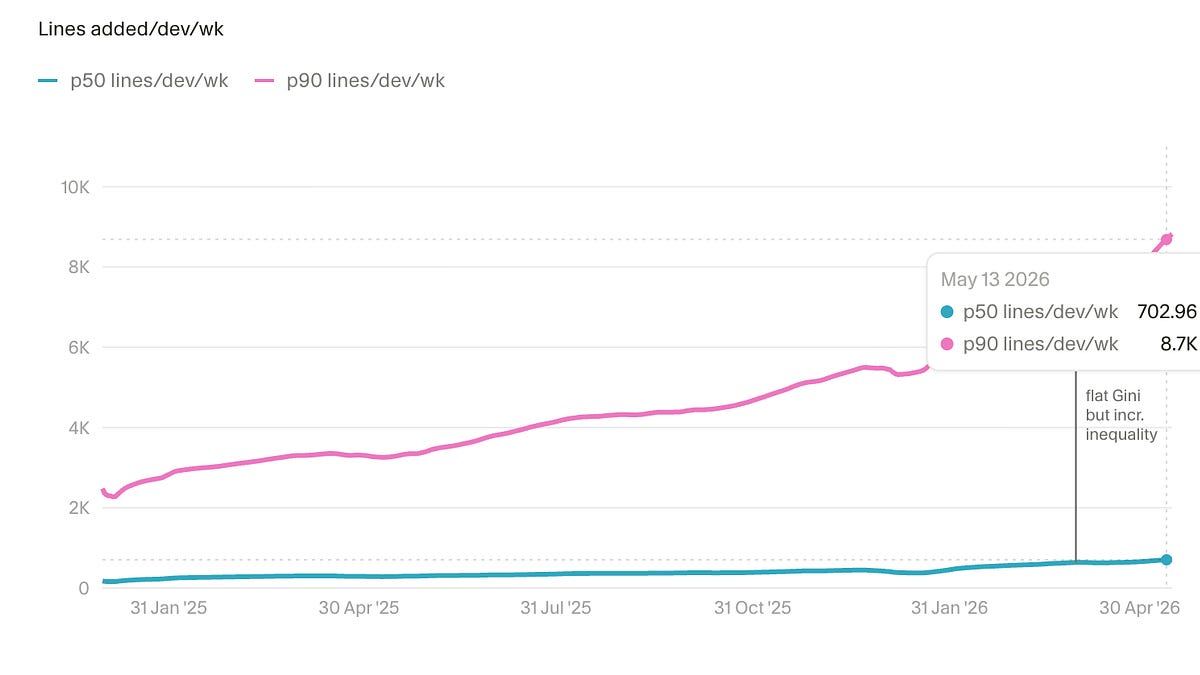 The Pulse: Interesting AI coding stats from Cursor
Pre-read: AI coding is becoming an operations problem before it becomes a settled productivity story. Cursor's own Developer Habits Report shows code volume rising, PRs growing, and agent sessions leaning heavily on context; a recent empirical study of 11,579 AI-assisted IDE sessions similarly frames modern programming as iterative specification and delegated comprehension. The important question is now where review, cost control, and architectural ownership live when agents can move faster than the old human loop.
Summary: Gergely Orosz extracts the operational signal from Cursor's report: power users generate around 10x the lines of code of median users, the top 1% generate roughly 30,000 to 40,000 lines per week, and Cursor's token mix has become mostly reading rather than writing. Cursor reports that input tokens now exceed 90% of non-cache token volume and that cache reads dominate total token activity, which means agentic coding economics depend heavily on context reuse rather than raw output pricing. The governance point is sharper: Cursor says agent-generated changes reaching commits without a separate manual diff acceptance step rose from 7% on January 1 to 36.3% by May 16. Orosz's useful caveat is that Cursor has incentives in model-cost comparisons, but the broader conclusion still lands: the scarce engineering resource is moving from typing to judgment, review design, test signals, and accountability for agent-made changes.
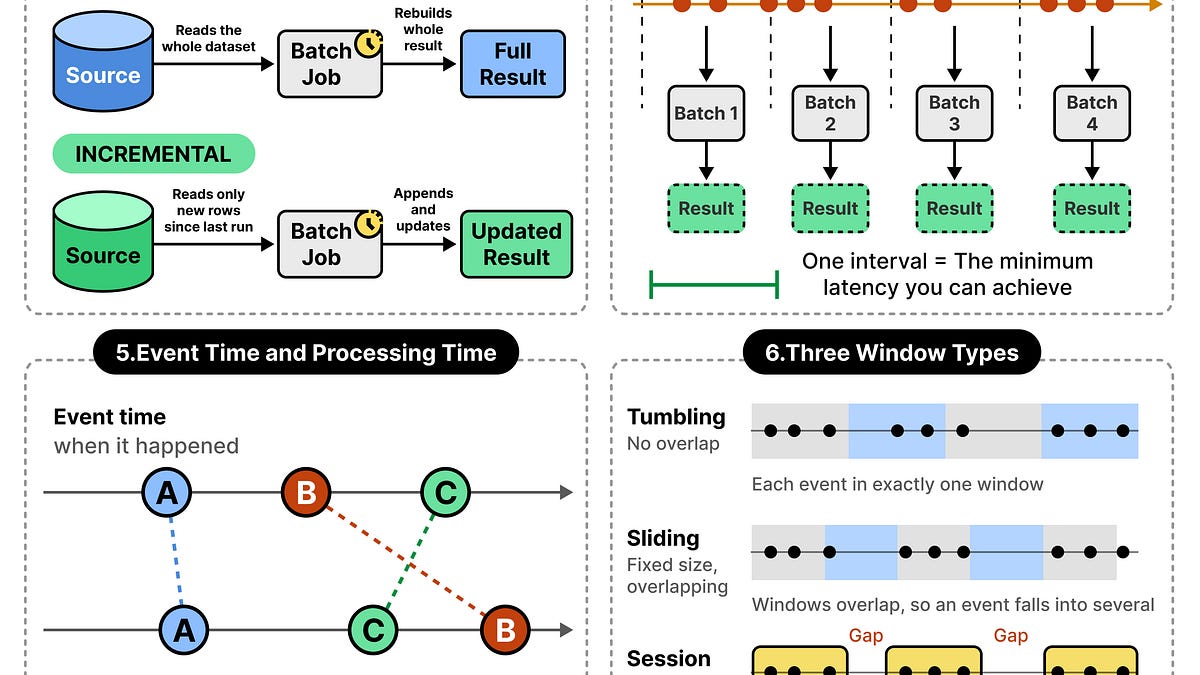 Streaming trades completeness for latency
Pre-read: The streaming-vs-batch distinction matters more as teams wire AI, telemetry, finance, and product systems into continuous decision loops. The core systems tradeoff is temporal: a batch job can wait for a closed dataset, while a streaming system must act before the world has finished reporting itself.
Summary: ByteByteGo explains the split through a single question: when is data complete enough to compute on? Batch processing waits for a natural boundary such as a finished file, business day, or large aggregation window, which gives cleaner correctness guarantees at the cost of latency. Streaming produces answers while events are still arriving, so it has to use windows, watermarks, late-data handling, and exactly-once machinery to keep speed from corrupting meaning. The piece is a compact refresher rather than a deep original argument, but it is useful for engineers designing real-time analytics, event-driven product features, model-monitoring loops, or robotics telemetry systems where late facts can change the answer after an action has already been taken.
Ideation
Sell facilities teams a live backlog of physical work that cheap robots can inspect, price, and eventually execute. The new primitive is not a humanoid worker; it is a continuously updated, robot-readable ledger of deferred maintenance, cleaning, safety hazards, and micro-repairs, with each task carrying location, evidence, risk, tool requirements, confidence, and a human approval path.
Source Signals:
What Would You Do if Labor Was Free? via It Can Think
The useful work is the work nobody currently does: re-caulking, cleaning, small repairs, inventory, and preventative maintenance.
Streaming vs Batch: Two Philosophies of Data Processing via ByteByteGo
Physical operations have the same completeness problem as streams: the building state never finishes arriving, so the system needs watermarks, late evidence, and revision history.
The Quest to Make Humanoid Robots Safe Enough for Humans via Web verification
Robot deployment near people is bottlenecked by safety layers, contextual hazard awareness, and standards.
China wants to solve the hardest problem in robotics - making hands via Web verification
Dexterous hardware is scaling, but manipulation data and control remain scarce.
Why Now: Robot hardware is getting cheaper before robot autonomy is fully trustworthy. That creates a wedge for the layer just before execution: map the neglected work, collect ground-truth state, route some jobs to humans or teleoperators today, and make the corpus executable by robots as capability improves.
First Wedge: A paid inspection-and-work-order system for multi-site warehouses, campuses, and property managers: phone capture plus low-cost rovers create verified micro-maintenance tickets, rank them by risk and cost, and export into ServiceNow, MaintainX, or existing CMMS tools.
Commercial Model: Facilities directors and risk managers pay per building or square foot because deferred maintenance already consumes budget through emergency repairs, insurance claims, downtime, and compliance misses. The first contract can be a 60-day audit subscription, then a recurring monitoring fee plus take-rate on fulfilled work.
Defensibility: The compounding asset is a cross-site map of small physical failure modes: what damage looks like early, which fixes prevent expensive outcomes, what task specs robots can actually complete, and which vendors or teleoperators close loops reliably. CMMS incumbents have tickets, not embodied evidence or robot-executable task graphs; robot OEMs have machines, not neutral demand aggregation across buildings.
Technical Risk: The hard part is turning messy visual and sensor evidence into trustworthy task specs without flooding operators with false positives. The system needs uncertainty handling, change detection, localization, and a safe handoff from observation to human or robotic action.
Market Expansion: Start with warehouses and campuses, then expand to hotels, multifamily housing, hospitals, retail chains, airports, and municipalities. The morphology is similar: repeated spaces, recurring wear, constrained maintenance budgets, and lots of small tasks below the threshold of human scheduling.
Self-Critique: This can collapse into a services-heavy inspection company or a generic CMMS feature. It only becomes a venture-scale company if the data model becomes the execution substrate for robot labor, not just a nicer punch list.
Next Experiment: In two weeks, walk 10 buildings with facilities managers, capture 500 defects, and produce priced work ledgers. Measure how many tickets they would fund immediately, how many were previously invisible, and whether one recurring defect class can be specified tightly enough for teleoperation or a simple robot trial.
Sell engineering leaders a control plane that gives autonomous coding agents limited, auditable budgets to change production systems. The primitive is a streaming risk ledger: every agent action spends from a policy budget based on blast radius, evidence quality, reversibility, test coverage, dependency freshness, and whether the system state is complete enough to merge.
Source Signals:
The Pulse: Interesting AI coding stats from Cursor via The Pragmatic Engineer
Cursor usage data shows power users producing far more code and a sharp rise in AI changes accepted without manual review.
Cursor Developer Habits Report: Agentic Coding Trends via Cursor
Cursor reports deeper agent sessions, larger units of work, rising AI-code survival, and nearly 9x variation in request costs across model families.
Streaming vs Batch: Two Philosophies of Data Processing via ByteByteGo
The same late-data problem appears in software changes: security scans, flaky tests, owner review, and production telemetry arrive on different clocks.
Why Now: Agentic coding is moving faster than human review can scale, and existing AI review tools are crowding around comment generation. The missing layer is not another reviewer; it is a budgeted merge authority that lets low-risk agent work pass quickly while forcing high-risk work to gather more evidence or spend human approval.
First Wedge: A GitHub/GitLab app for teams already using Cursor, Codex, Claude Code, or internal agents. It classifies each agent-authored PR, attaches a risk budget, gates merge rights, chooses the cheapest sufficient model for extra checks, and leaves an audit trail for security and engineering leadership.
Commercial Model: VPs of engineering, platform teams, and regulated-product security teams pay per active developer or per repository because review capacity, incidents, and model spend are already budget lines. The urgent buyer is the team whose agents are creating more changes than senior engineers can responsibly inspect.
Defensibility: The advantage compounds through outcome-labeled change data: which agent edits failed, which tests were predictive, which owners caught what, which services tolerate autonomy, and which model checks were worth their cost. Code review incumbents can comment on diffs; the harder product is becoming the policy memory for autonomous engineering work across repos and incidents.
Technical Risk: The core hard problem is risk calibration. If the ledger blocks too much, developers route around it; if it trusts the wrong signals, it creates a false sense of safety. It must integrate tests, ownership, secrets, dependency graphs, runtime telemetry, and rollback semantics without becoming brittle governance theater.
Market Expansion: After code, the same budget model applies to infrastructure changes, data migrations, customer-support actions, procurement agents, and eventually physical robot jobs. Any autonomous system that can act before all evidence is complete needs a spendable risk budget and a delayed-evidence reconciliation loop.
Self-Critique: This market is noisy with AI code review, AppSec, and SDLC governance vendors. The wedge only works if it is framed around agent authority and merge budgets, not prettier review comments or generic compliance dashboards.
Next Experiment: Instrument 20 agent-authored PRs at two teams, score each before merge, and compare the score against human review outcomes, test failures, rollback need, and post-merge incidents. The validation question is whether the system can auto-clear a meaningful fraction of low-risk PRs while catching the scary ones humans would have missed.