World
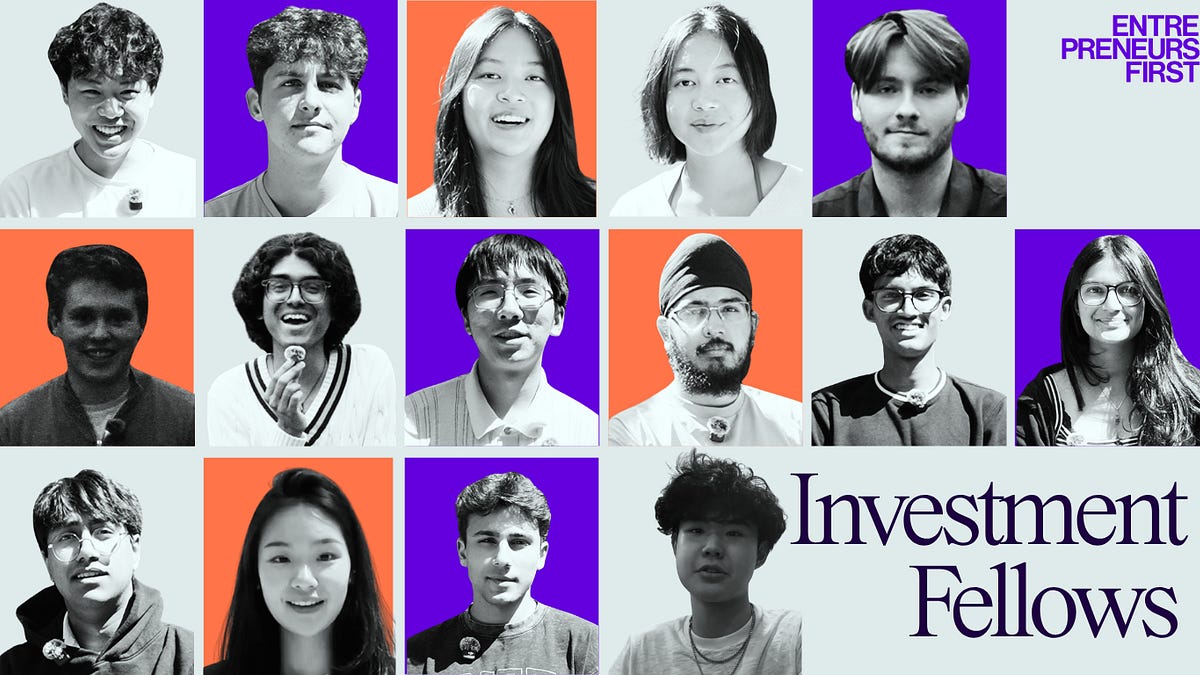 Introducing the next cohort of EF North America Investment Fellows
Entrepreneurs First announced its second North America Investment Fellows cohort, a campus-and-community scout network meant to find founder-caliber people before they have a company, cofounder, or polished fundraising narrative. The update is most useful as a quick read on EF's talent-sourcing thesis: early-stage venture firms are pushing discovery upstream into trusted local networks, where judgment and proximity can matter before conventional startup signals exist. EF says the first cohort produced founder introductions, at least one investment, an intern, and a Talent Investor hire; the new cohort spans Columbia, Rose-Hulman, Claremont McKenna, UC Santa Barbara, Georgia State, Western University, Penn, Purdue, Chicago, Stanford, McMaster, UBC, Toronto, and UT Austin.
Ideation
Sell banks, insurers, and healthcare administrators a custody layer for the corrections, exceptions, evals, traces, and approval rationales that make their agents useful. The product is not another model gateway. It is the customer-owned record of how the institution decides, packaged so it can audit an agent, retrain a task model, or switch vendors without donating its operating judgment to the model provider.
Source Signals
- The Reverse Information Paradox via TLDR
Flagged the core asymmetry: customers pay for AI and then teach the vendor with proprietary corrections, prompts, traces, and memory. - Own Your Weights via TLDR Founders
Argued that most companies want control benefits without the operational tax of owning every model weight. - Wall Street banks ramp up digital assistants in bid to win productivity race via Reuters Week Ahead
Banks are moving assistants into daily work, exactly where high-value human exceptions and approvals are created. - House committees investigate Airbnb, Anysphere, and PRC-origin AI model risk via The Daily Upside
Model choice is becoming a provenance and jurisdictional-risk decision, not just a price/performance decision.
Why Now: Model prices are compressing, Chinese open-weight models are pulling enterprises into multi-vendor setups, and regulated firms are finally deploying agents where humans make consequential exceptions. The scarce asset is shifting from the base model to the institution-specific judgment trail.
First Wedge: Start with loan-review or claims-adjustment copilots. Capture every human override, cited policy, customer-specific exception, model input, output, and final decision into a signed customer-owned judgment ledger with exportable eval sets and retraining packs.
Commercial Model: Chief risk, compliance, and operations leaders pay an annual platform fee plus workflow volume. The budget comes from AI governance, model-risk management, and vendor-risk spend because the product reduces audit pain and preserves switching leverage before agent contracts harden.
Defensibility: The moat is the normalized corpus of decision traces, mappings into regulated workflows, and trust with model-risk teams. Incumbent model vendors are conflicted because their lock-in improves when the customer's corrections stay inside their runtime.
Technical Risk: The hard part is lossless capture across messy tools without slowing workers down, then separating durable institutional judgment from noise, PII, and one-off hallucination fixes. Bad capture turns the ledger into expensive logs.
Market Expansion: After loans and claims, the same primitive applies to prior authorization, AML reviews, wealth-advice supervision, pharma medical review, and government benefits: any workflow where an agent proposes and a licensed human explains the exception.
Self-Critique: Generic agent observability and governance are crowded. This only clears the bar if the wedge is custody of regulated human judgment with audit and portability rights, not dashboards for prompts.
Next Experiment: In two weeks, shadow 200 decisions in one claims or credit team, build the judgment schema, and show the head of risk a vendor-switch packet: evals, decision examples, policy citations, and a fine-tuning/RAG export that recreates current behavior on a second model.
Sell insurers and city licensing offices a continuous certificate that proves a public venue still matches its safe operating state after renovations, crowd-flow changes, blocked exits, decorations, wiring work, and acoustic upgrades. The primitive is physical-state evidence: phone scans, fixture photos, sensor feeds, and staff checklists turned into a time-stamped risk graph that a human inspector can audit.
Source Signals
- Bangkok pub fire kills 27 via Reuters Week Ahead
Authorities and experts examined familiar failure modes: flammable interiors, electrical issues, insufficient escape routes, and possible blocked exits. - Where AI Stands in Fire & Life Safety: A 2025 Snapshot via Prior-art check
Fire safety AI already helps with design checks and reporting, so the sharper wedge is continuous operational proof rather than generic inspection automation. - NEO's Hands | An API to the Physical World via TLDR
Embodied systems are moving from passive vision toward touch and action, suggesting future inspections can collect physical evidence instead of only photos. - AI's Biggest Winners Have the Lowest Margins via TLDR Founders
Low-margin operators benefit when agents attack coordination costs that humans cannot afford to monitor continuously.
Why Now: Life-safety risk changes between annual inspections, while cameras, phones, cheap sensors, and frontier vision models can now collect enough evidence for a human reviewer to catch drift. Insurers also have a direct incentive to price venues that prove exits, materials, occupancy paths, and systems are kept safe.
First Wedge: Nightclubs, event halls, and small music venues: monthly guided phone scans plus required change-event scans after renovations, stage changes, or decor installs. The output is an insurer-accepted certificate and a short exception list for the owner.
Commercial Model: Venues pay a subscription only if it lowers insurance friction, speeds permit renewals, or avoids surprise shutdowns. Insurers or brokers can subsidize it because better evidence improves underwriting and claims defensibility.
Defensibility: The company compounds a venue-risk dataset tied to actual operating layouts, materials, change history, and remediation outcomes. Fire-code software incumbents own forms and inspection workflows, but not necessarily the live physical-state history that underwriters can price.
Technical Risk: Vision models must reliably identify blocked egress, risky materials, fixture changes, and missing safety equipment from inconsistent scans. False negatives are life-safety failures; false positives make operators ignore the system.
Market Expansion: Start with nightlife and event venues, then expand to restaurants, schools, warehouses, hotels, and assisted-living facilities. The common morphology is occupancy risk that changes faster than the inspection cadence.
Self-Critique: This can die as a small compliance tool if regulators and insurers refuse to treat the certificate as meaningful. It also cannot pretend to replace inspectors; the sellable product is better evidence and faster human review.
Next Experiment: Scan 20 local venues with a fire-safety consultant, compare the system's findings with a manual walkthrough, and ask two brokers what premium credit or renewal-condition language would make owners buy in 30 days.