World
1 critical / 1 happenings
 BMW races to catch up in a Chinese EV market that won't slow down
Pre-read: China has shifted from being the growth market for German automakers to being the stress test for their product cycles. Domestic EV makers now update faster, price harder, and export more aggressively, while foreign premium brands carry older architectures and higher cost bases. The broader backdrop is a steep China sales drop across Volkswagen, BMW, Mercedes, and Porsche reported by AP and reinforced by current market data.
Summary: Reuters reports that BMW is betting on its Neue Klasse EVs to revive China after two years of declining sales, but the launch risks arriving into a market that has already moved on. BMW's China sales have fallen for two consecutive years and are on track for a third, even with heavy discounts.
The article's sharper point is that China's EV cycle has compressed around software, price competition, and fast model refreshes. Premium German positioning is weaker when local rivals can offer better-connected EVs at lower prices. That makes BMW's new CEO Milan Nedeljkovic's China turnaround a test of whether legacy automakers can adapt their cadence, not just their drivetrains.
Pre-read: Energy policy now moves through capital allocation as much as regulation. When subsidies, tax credits, and permitting signals change, factories and grid projects can stall before any formal ban appears.
Summary: Reuters reports that the BlueGreen Alliance linked Trump administration clean-energy rollbacks to $82.9 billion in delayed or canceled investment across 223 manufacturing and clean-energy projects. The group also estimated 111,765 associated jobs stalled or canceled.
The article attributes the pullback to the administration's tax-and-spending package, curbs on Biden-era incentives, and other federal actions reducing support for renewable energy and EVs. Treat the numbers as an advocacy-group analysis rather than neutral government accounting, but the direction is important: policy volatility is becoming a financing risk for industrial decarbonization. Reuters Auto File surfaced it because the effects land directly on EV supply chains, factories, and regional jobs.
Tech
2 critical / 2 happenings
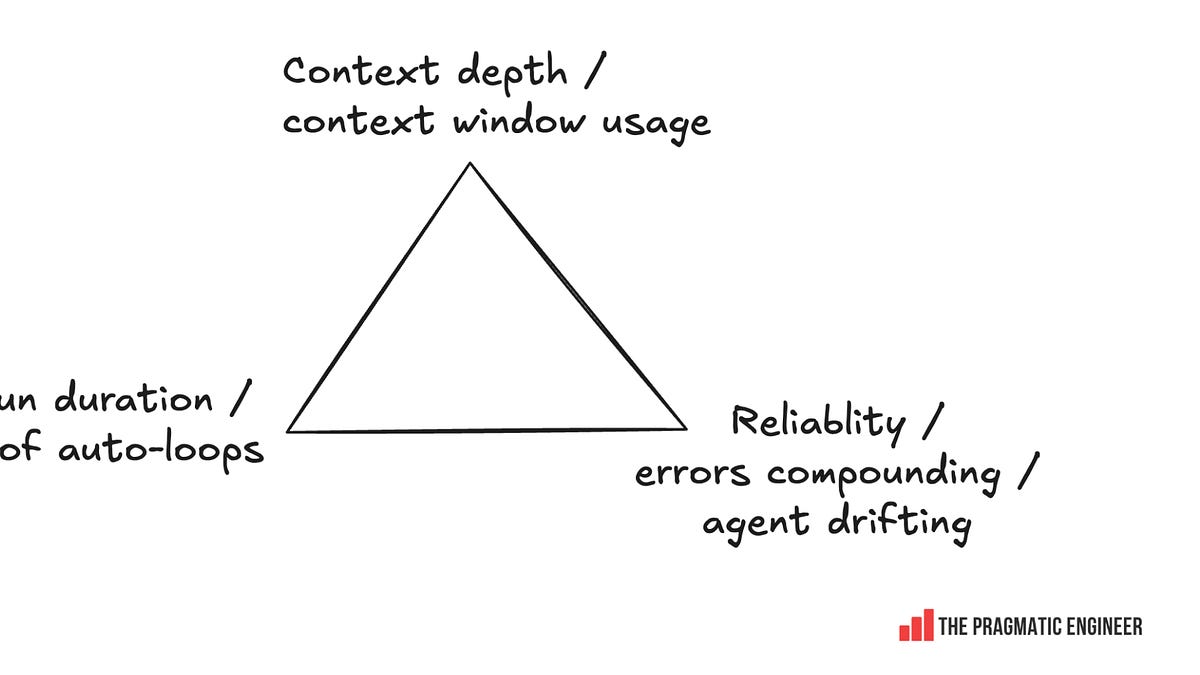 What is loop engineering?
Pre-read: Coding agents are moving from single-turn prompting toward durable systems with state, triggers, retries, and stop conditions. The useful frontier is shifting from prompt wording to verifier design, because a loop can only improve against the feedback it can see. Addy Osmani's framing and the Ralph-to-loop critique both point at the same operating question: who owns judgment when generation is continuous?
Summary: Gergely Orosz traces "loop engineering" from Geoffrey Huntley's Ralph-style bash loops to recent /goal-style harnesses and scheduled agent workflows. The piece argues that many examples are familiar cron jobs or event triggers with an LLM inside, but the workflow becomes interesting when the agent can investigate, act, update state, and rerun under explicit success criteria.
The strongest sections are the concrete dev workflows: agents opening PRs from Sentry issues, triaging outage channels, fixing flaky tests, reviewing implementation plans until no major issues remain, and running migrations in small repeated passes. The caution is equally concrete. Loops drift, burn tokens, hit context limits, and often require a human to judge whether the output solved the problem or merely satisfied a weak check.
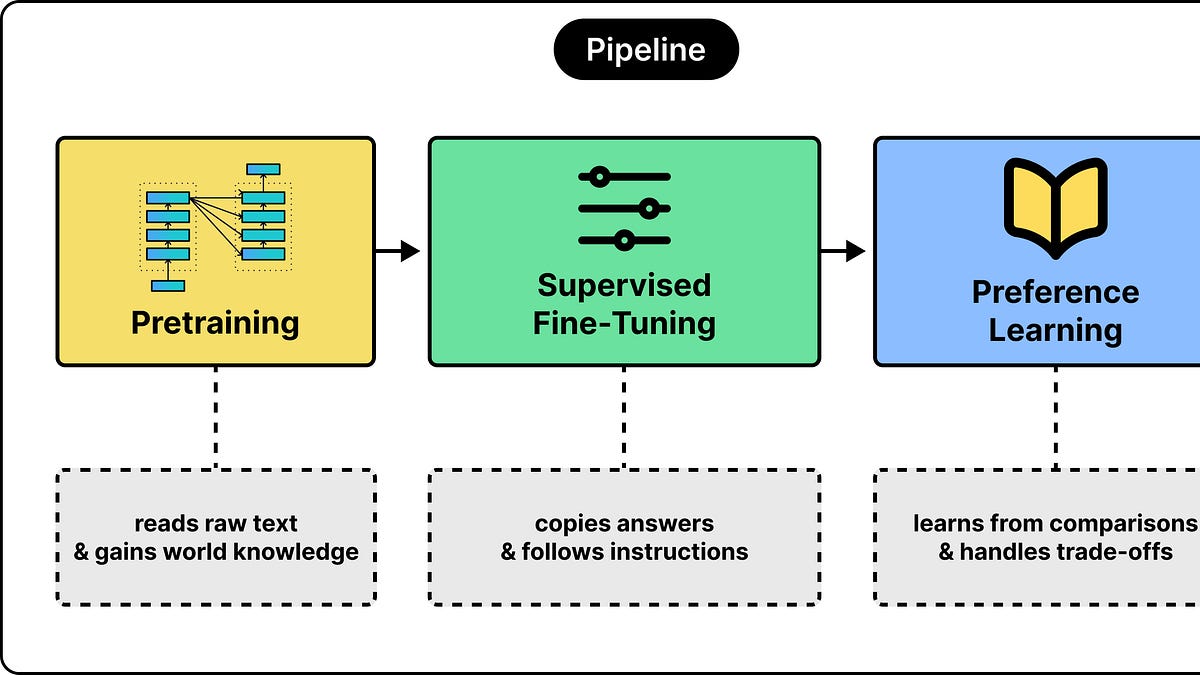 How LLMs Learn to Be Helpful (RLHF vs DPO)
Pre-read: Alignment is often the cheapest way to change a model's usefulness because it trains the model on preference tradeoffs rather than raw next-token prediction. OpenAI's InstructGPT paper showed that a much smaller aligned model could beat a much larger base model in human preference tests. That result explains why the post-training layer has become as strategically important as pretraining scale.
Summary: ByteByteGo gives a clean walkthrough of the post-training stack: pretraining gives broad capability, supervised fine-tuning teaches instruction following, and preference learning teaches the model how to choose between multiple plausible answers. RLHF does this by training a reward model from comparisons and then using reinforcement learning to optimize the policy against that scorer.
DPO collapses much of that machinery into a direct preference loss, following the insight from the DPO paper that the policy can implicitly carry the reward model. The article's best point is that both methods inherit the same Goodhart problem: human preference data is still a proxy, so optimizing it too hard can produce sycophancy, verbosity, or confident agreeableness. For math and code, verifiable rewards can replace that proxy; DeepSeek-R1 is the reference example of reasoning gains from RL on checkable tasks.
 Space mirrors reach the licensing layer
Pre-read: Low launch costs are turning exotic orbital infrastructure into a governance problem before it is a mature business. The hard question is less whether a prototype can unfold a mirror than whether private actors can alter shared skies without a durable environmental review regime.
Summary: Reflect Orbital received FCC clearance for Eärendil-1, a prototype low-Earth-orbit mirror satellite with an 18-meter reflective surface. The Verge reports that the company wants to redirect sunlight after dark for uses such as solar energy, agriculture, emergency response, and construction.
The approval is limited to a demonstration satellite, but the company's larger ambition is a much bigger constellation. Critics including astronomy and dark-sky groups warn about optical astronomy, wildlife, aviation, and light-pollution risks. The FCC order, available as a primary authorization document, makes this a useful early case study in how regulators handle physical-world side effects from space startups.
Pre-read: Ukraine made the attritable-drone cost curve impossible for legacy militaries to ignore. A force that can trade thousands of dollars of hardware for millions of dollars of armor changes procurement, doctrine, training, and manufacturing timelines at once.
Summary: Hardware FYI's lead item frames the new tank problem as economic warfare: cheap FPV drones, fiber-optic variants, motherships, and quadcopters are forcing armored systems into a rapidly evolving design race. WSJ's current reporting says Neros won a potential $500 million U.S. Army contract for low-cost FPV attack drones, tying the battlefield lesson to formal U.S. procurement.
The important shift is institutional. Low-cost unmanned systems are moving from improvised wartime adaptation into planned production programs, with the Pentagon trying to scale toward mass quantities rather than exquisite platforms. That creates a new bottleneck around domestic components, operator training, counter-drone defenses, and evidence that cheap systems work outside demonstration conditions.
Ideation
Sell a liability-grade recorder for autonomous loops that act in the physical world: drones, robot fleets, orbital infrastructure, industrial robots, and AI-operated equipment. The product captures the full causal chain before an action happens - model version, sensor context, tool calls, operator approvals, constraints, overrides, and post-action effects - then turns it into evidence that insurers, regulators, buyers, and internal safety teams can trust.
Source Signals
- The Cheap Drone Problem for Tanks via Hardware FYI
Cheap drones are collapsing the cost ratio between attacker and target; when expendable autonomous systems become numerous, after-action evidence and fleet-level safety boundaries become part of the product. - FCC DA 26-706 Reflect Orbital authorization via FCC / Hardware FYI
Reflect Orbital's Eärendil-1 approval shows a private company moving toward controllable physical effects in a shared commons, with public objections around astronomy, wildlife, aviation, and light pollution. - What is loop engineering? via The Pragmatic Engineer
Agent work is moving from one-off prompts toward triggers, cron jobs, and persistent loops. That is manageable in software; it becomes a liability surface when loops command machines. - Apple sues OpenAI for allegedly stealing hardware secrets via TLDR / Daily Upside / The Verge
The lawsuit, which OpenAI disputes, is a reminder that hardware AI companies need independent-development records, not just security policies, when talent and suppliers move between competitors.
Why Now: Frontier systems are getting cheap enough to sit inside recurring loops, and those loops are leaving the browser. A drone strike, a greenhouse robot action, a warehouse forklift decision, or a satellite illumination command needs a record that explains what the system knew, which guardrail allowed the action, who could have stopped it, and what happened afterward.
First Wedge: Start with retrofit autonomy vendors for heavy equipment and industrial sites. Give them a tamper-evident action log, replayable incident bundle, and customer-facing safety report that can be attached to insurance renewals, enterprise procurement, and regulator conversations.
Commercial Model: Autonomy vendors pay per deployed machine or per operating site because the recorder helps them close risk-sensitive customers and lowers post-incident legal exposure. Larger operators and insurers pay for independent review seats, fleet risk dashboards, and verified incident exports.
Defensibility: The compound asset is a cross-vendor corpus of physical autonomy incidents, near misses, operator overrides, environment states, and remediation patterns. Fleet-management tools see telemetry; this company owns the evidentiary layer that buyers, insurers, and regulators learn to request by name.
Technical Risk: The hard part is building logs that are complete enough for liability without becoming impossible to integrate. The system has to normalize sensor summaries, model traces, human approvals, policy constraints, and physical outcomes across messy machines while staying tamper-evident and cheap enough to run continuously.
Market Expansion: After heavy equipment, expand into warehouse robots, drone inspection fleets, farm robotics, autonomous construction, space-infrastructure demos, and any AI hardware team that needs clean-room provenance for design decisions. The same primitive applies wherever autonomous loops touch property, labor safety, regulated infrastructure, or shared commons.
Self-Critique: This can die as middleware that everyone says is prudent and nobody budgets for. The wedge has to attach to a painful transaction - insurance, enterprise procurement, safety certification, or incident defense - not to a vague desire for better observability.
Next Experiment: Interview 12 autonomy vendors and three specialty insurers. Ask for the last customer security or safety questionnaire that slowed a deal, then build a two-week prototype that converts one robot's existing logs into a replayable incident packet an insurer would actually read.