Tech
1 critical / 1 happenings
 Agility Robotics plants its flag in Tesla's backyard
Pre-read: Humanoid robotics is moving from stage demos into the harder question of repeatable industrial deployment. The useful boundary is shifting toward task scoping, facility integration, safety evidence, and buyer trust. NVIDIA's Halos robotics safety stack and the updated ANSI/A3 R15.06-2025 robot safety standard show how much of the race now sits around certifiable systems, not just dexterity. This article clarifies where a commercial humanoid company is placing its operating bet.
Summary: TechCrunch reports that Agility Robotics opened a 60,000-square-foot Fremont facility near Tesla's expected Optimus manufacturing base. The site is meant to train and test Digit's physical AI while keeping Agility close to Bay Area AI talent. Agility says Digit is already generating revenue in manufacturing and warehouse settings, with customers including Amazon, GXO, Schaeffler, and Toyota Motor Manufacturing Canada, and the company says it has secured $300 million in contract orders.
CEO Peggy Johnson frames the company's lead around commercialization: meeting safety, regulatory, compliance, IT, and warehouse-management requirements inside real facilities. Co-founder Damion Shelton also draws a hard line between generative AI for scaling behavior and deterministic safety systems, arguing that safety should not sit under a creative model. The most useful takeaway is the near-term market shape: bins, totes, picking, kitting, cardboard, and trailer loading before the home robot fantasy.
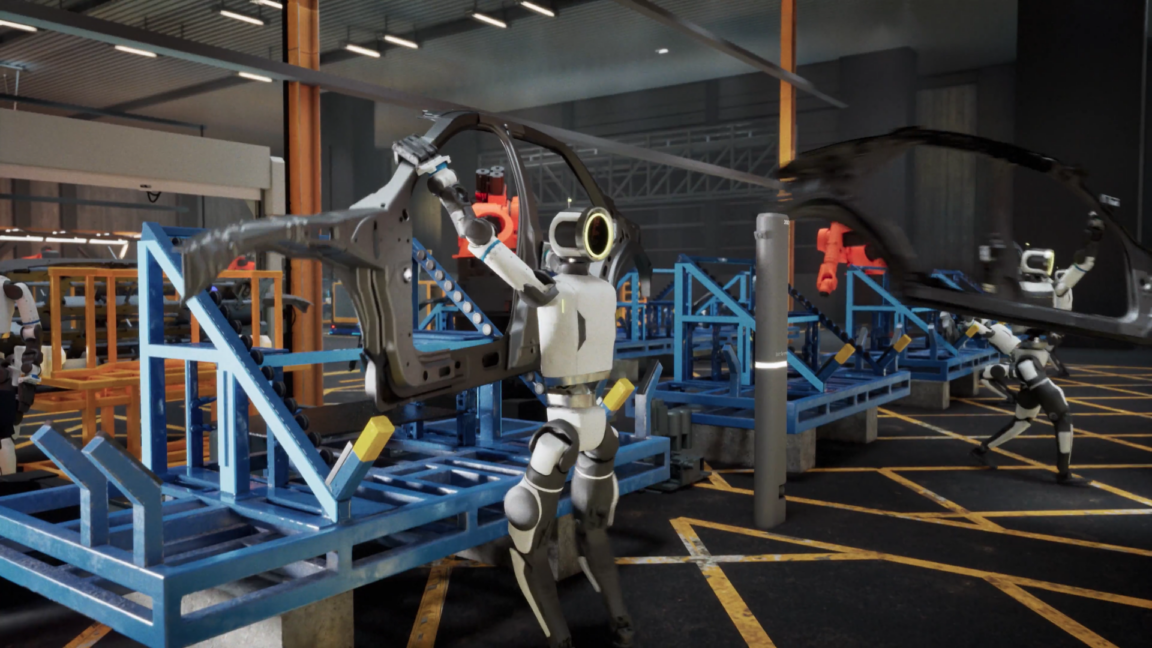 Robot deployment now has labor veto risk
Pre-read: Factory automation decisions travel through unions, work rules, wage systems, and local politics before they become operating reality. Humanoid robots make that negotiation more visible because they look like direct labor substitutes, even when managers describe them as complements. Hyundai and Boston Dynamics publicly unveiled Atlas at CES 2026, setting up labor scrutiny well before broad deployment.
Summary: Ars Technica reports that thousands of Hyundai workers in South Korea began partial walkouts after negotiations broke down, with humanoid robot deployment among the contested issues. The broader WSJ-reported dispute centers on worker demands for safeguards before Atlas enters production lines, plus wage, retirement-age, and job-protection terms. The labor action is being treated as an early test case for how unions respond when humanoid robotics becomes a concrete factory plan rather than a research demo.
The strategic point is that deployment permission can become a bottleneck even when the robot roadmap looks technically plausible. Hyundai plans to put Atlas into U.S. factories first, and coverage has pointed to 2028 as the target for the Georgia Metaplant. That means the risk for robotics companies and industrial buyers is now partly institutional: adoption depends on proof that tasks, staffing effects, safety envelopes, and economic gains are legible to workers as well as executives.
Ideation
Sell manufacturers a deployment-permission system for humanoid robots: a live operating envelope that turns robot tasks, safety evidence, human proximity rules, retraining commitments, and labor-contract constraints into auditable permits for each workcell. The primitive is not robot control. It is a machine-readable labor and safety bargain that lets a plant prove what a robot is allowed to do today, what changed since last week, and who signed off.
Source Signals
- Silicon Valley is leading the world in robotics via Robots & Startups
The newsletter framed the Bay Area robotics cluster around real deployment infrastructure, not just prototypes. - Agility Robotics plants its flag in Tesla's backyard via TechCrunch
Agility's Fremont facility is explicitly for training and testing Digit in realistic industrial workflows. - Agility opens new Fremont facility to accelerate physical AI development via Agility Robotics
Agility names active enterprise deployments and more than $300 million in Digit V5 orders, while keeping the near-term focus on factories, warehouses, and logistics. - Fear of humanoid robots spurs human workers to strike at Hyundai auto factory via Ars Technica
The Hyundai dispute shows the deployment blocker can be worker permission and job safeguards before robots ever reach technical scale. - NVIDIA Halos for Robotics via NVIDIA
Technical safety is already becoming platform infrastructure, which leaves a narrower opening for evidence that operators, insurers, unions, and regulators can all use.
Why Now: Humanoids are moving from trade-show demos into named enterprise deployments, but the safety case now has to survive changing tasks, shared spaces, and labor scrutiny. Generic safety stacks and robot training data are consensus markets; the less crowded wedge is permission to operate inside a specific plant under a specific labor and insurance regime.
First Wedge: Start with unionized or high-scrutiny manufacturing sites running their first humanoid pilot. Ship a permit file for one task family, such as tote movement or line-side kitting: allowed zones, speed limits, near-miss logs, fallback behavior, human override points, training obligations, and weekly change reports that management and worker representatives can inspect.
Commercial Model: The buyer is the VP of manufacturing, EHS leader, or automation program owner whose robot pilot can be delayed by safety review, insurer objections, or labor escalation. Charge a site setup fee plus per-robot or per-workcell annual software tied to keeping pilots live, expanding permitted tasks, and reducing approval cycle time.
Defensibility: Every deployment adds a library of task envelopes, incident taxonomies, sign-off templates, insurer questions, and model-specific failure patterns. Robot OEMs can build internal safety tools, but they have weak credibility as the neutral recordkeeper when labor or insurance asks whether the deployment terms were honored.
Technical Risk: The hard part is translating messy robot logs, video events, PLC/MES state, and human proximity data into concise evidence that is complete enough for safety review without becoming surveillance theater. The product also needs adapters into robot fleets and factory systems without slowing the line.
Market Expansion: After humanoid pilots, the same permit primitive applies to autonomous forklifts, AMRs crossing pedestrian zones, construction robots, shipyard robots, and hospital service robots. Expansion follows sites where mobile embodied systems enter human workspaces and where permission is renewed task by task.
Self-Critique: This could collapse into consulting if the software cannot standardize evidence across sites. It may also be too early if most buyers stay in tiny pilots or avoid unionized plants. NVIDIA, robot OEMs, safety integrators, or EHS platforms could absorb pieces of the workflow, so the wedge has to become the trusted shared record rather than another dashboard.
Next Experiment: In two weeks, interview five automation leaders, three EHS managers, two labor-side manufacturing experts, and two insurers. Use one real humanoid or AMR pilot to mock a permit packet, then test whether it shortens an approval meeting or reveals a deployment blocker the buyer had not documented.