World
2 critical / 2 happenings
 Inside Ukraine's Kill Zone
Pre-read: The Ukraine front has become a live laboratory for cheap sensors, loitering munitions, electronic warfare, and dispersed command. The Institute for the Study of War has repeatedly framed the conflict as an adaptation race, where tactical advantage decays quickly once both sides copy it. Drone density changes the geometry of survival, logistics, and maneuver.
Summary: Reuters built an immersive reconstruction of the front-line kill zone, the strip around the line of contact where surveillance and attack drones hunt movement. The piece explains why massed troops and exposed artillery have given way to soldiers hiding for long periods in small, isolated positions. Reuters' framing is useful because it treats drones as a system, not a gadget: detection, targeting, FPV attack, countermeasures, and terrain all interact. The implication is stark for robotics and autonomy work outside defense too. Cheap embodied systems become strategic when they are networked, attritable, and operationally integrated.
 Kalshi Bets Election Fever Will Drive Platform Growth
Pre-read: Prediction markets are becoming information infrastructure before they become mainstream trading venues. The regulatory perimeter remains unsettled because event contracts overlap with gambling, derivatives, election law, and corporate compliance; law firm Morrison Foerster has warned that insider-trading controls may not naturally cover event-market accounts. That matters most when contracts attach to politics, trials, regulators, or operational secrets.
Summary: The Daily Upside reports that Kalshi launched a midterm-election hub after a World Cup surge that brought 3 million new users and $1.2 billion traded on the winner contract. It cites Ticker Tracker estimates that Kalshi processed about $40 billion in sports bets overall during the tournament. The article also notes expansion into FDA-trial outcome contracts, CFTC movement on perpetual futures, and state injunctions in Washington, Massachusetts, Michigan, and Nevada. Kalshi says 75% of visitors come only to view odds, which means the product is already a public probability feed. A linked working paper argues prediction-market accuracy often comes from roughly 3% of skilled users, with the majority supplying liquidity. The market may become useful as an intelligence layer while also creating new manipulation and insider-risk surfaces.
 Generic tariffs meet thin drug margins
Pre-read: Generic drugs are a scale-and-compliance business with little pricing power compared with patented pharma. The FDA's domestic manufacturing push includes PreCheck for new U.S. facilities and an ANDA prioritization pilot for certain domestically manufactured generics, but regulatory readiness is slower than tariff politics.
Summary: The Daily Upside reports that President Trump threatened 100% tariffs on imported generic drugs starting in August 2028, doubling to 200% a year later if companies do not reshore manufacturing. The article contrasts patented drugmakers, which have pledged more than $500 billion in U.S. production and development, with generic manufacturers that compete after patents expire and operate on thinner margins. It notes that generic prices can fall by up to 70% within two years of competition, while generics account for more than 90% of U.S. prescriptions but less than 18% of medication spending. Dr. Reddy's CEO Erez Israeli said higher tariffs would mean higher U.S. prices, and a New Delhi think tank said many Indian generics may remain cost-competitive even with 100% tariffs. Shares in Sandoz, Lupin, and Dr. Reddy's sold off after the proposal. The practical question is whether patients and insurers pay before supply chains actually move.
Pre-read: Maritime chokepoints turn regional conflict into global inflation pressure because insurance, routing, and inventory costs move before physical shortages arrive. The U.S. Energy Information Administration has described the Strait of Hormuz as a key oil transit route, and the Red Sea route matters because it offers Saudi Arabia and global shippers an alternative path when Gulf traffic is stressed.
Summary: Reuters' Daily Briefing says the Iran-aligned Houthis claimed attacks on two Saudi oil tankers in the Red Sea as part of a naval blockade on Saudi Arabia. Reuters framed the move as a threat to create a second chokepoint on global oil supplies alongside the Strait of Hormuz crisis. The same briefing said the U.S. military had completed a new round of strikes on Iran, keeping the escalation ladder active. An AP report on the same development says the Bab el-Mandeb route is critical for global trade and that a blockade could force rerouting around Africa, raising costs and delays. The Houthi claim may still require battlefield verification, but markets and shippers react to credible threat envelopes, not only confirmed damage.
Tech
2 critical / 2 happenings
 WebMCP
Pre-read: Web agents are bottlenecked less by language understanding than by reliable actuation: forms, buttons, state, permissions, and recovery after a wrong click. The existing Model Context Protocol gives agents structured access to external tools, while browsers still expose most websites as surfaces meant for humans. A web-native tool layer would move part of the agent stack from brittle screen interpretation into declared capabilities.
Summary: Chrome's WebMCP documentation describes a proposed standard that lets websites expose structured tools to AI agents through JavaScript and annotated HTML forms. The point is to let an agent discover actions such as checkout, filtering, or support flows with schemas and state instead of guessing from the DOM. The docs frame WebMCP as a progressive enhancement: humans still use the website, while agents get a more reliable path for task completion. The security surface is obvious and important. Once sites become callable by agents, web teams will need permission boundaries, evals, abuse testing, and user-visible proof of what an agent did.
 Science Corp. Announces European Commercial Launch of PRIMA
Pre-read: Retinal implants sit at the hard edge of embodied computing: they need surgery, training, reimbursement, clinical workflow, and evidence that a sensory interface works outside a demo. Geographic atrophy from age-related macular degeneration is a large unmet-need market, and the FDA Breakthrough Devices Program exists for devices that may offer more effective treatment for serious conditions. Commercial launch is where the system around the implant becomes as important as the device.
Summary: Science Corp. said PRIMA has CE marking and is beginning European commercialization for geographic atrophy caused by age-related macular degeneration. The system combines a subretinal photovoltaic implant with camera-equipped glasses and image processing to restore functional central vision. The company says country reimbursement and site activation are underway in Europe, while the device has FDA Breakthrough Device and Humanitarian Use Device designations in the United States. The durable signal is that neural interface companies are moving from proof-of-concept hardware toward reimbursement, surgeon training, patient selection, and outcomes operations.
 OpenAI productizes governed voice agents
Pre-read: Enterprise agents are becoming deployment programs, not API calls. The hard parts are policy scope, tool permissions, evaluation, escalation, change control, and liability when an agent acts inside customer or employee workflows.
Summary: OpenAI introduced Presence, a limited-general-availability product for enterprise voice and chat agents. It bundles workflow scoping, company policies, approved actions, simulations, graders, guardrails, escalation rules, and a Codex-powered improvement loop. OpenAI says Presence powers its English-language phone support channel and resolves 75% of inbound issues without human assistance; it also says Codex-driven updates reduced human handoffs by 15 percentage points in 10 days. Deployments are led by OpenAI Forward Deployed Engineers and select systems integrators, not offered as self-serve software. The launch is promotional, but it shows where model labs think enterprise agent margin will live: controlled action systems around the model.
 Cheaper AI pressures hyperscaler capex
Pre-read: AI infrastructure economics are now a public-market story: investors want proof that huge data-center budgets convert into durable revenue and margin. Cheap inference changes the math because it can expand usage while compressing the price umbrella for premium models.
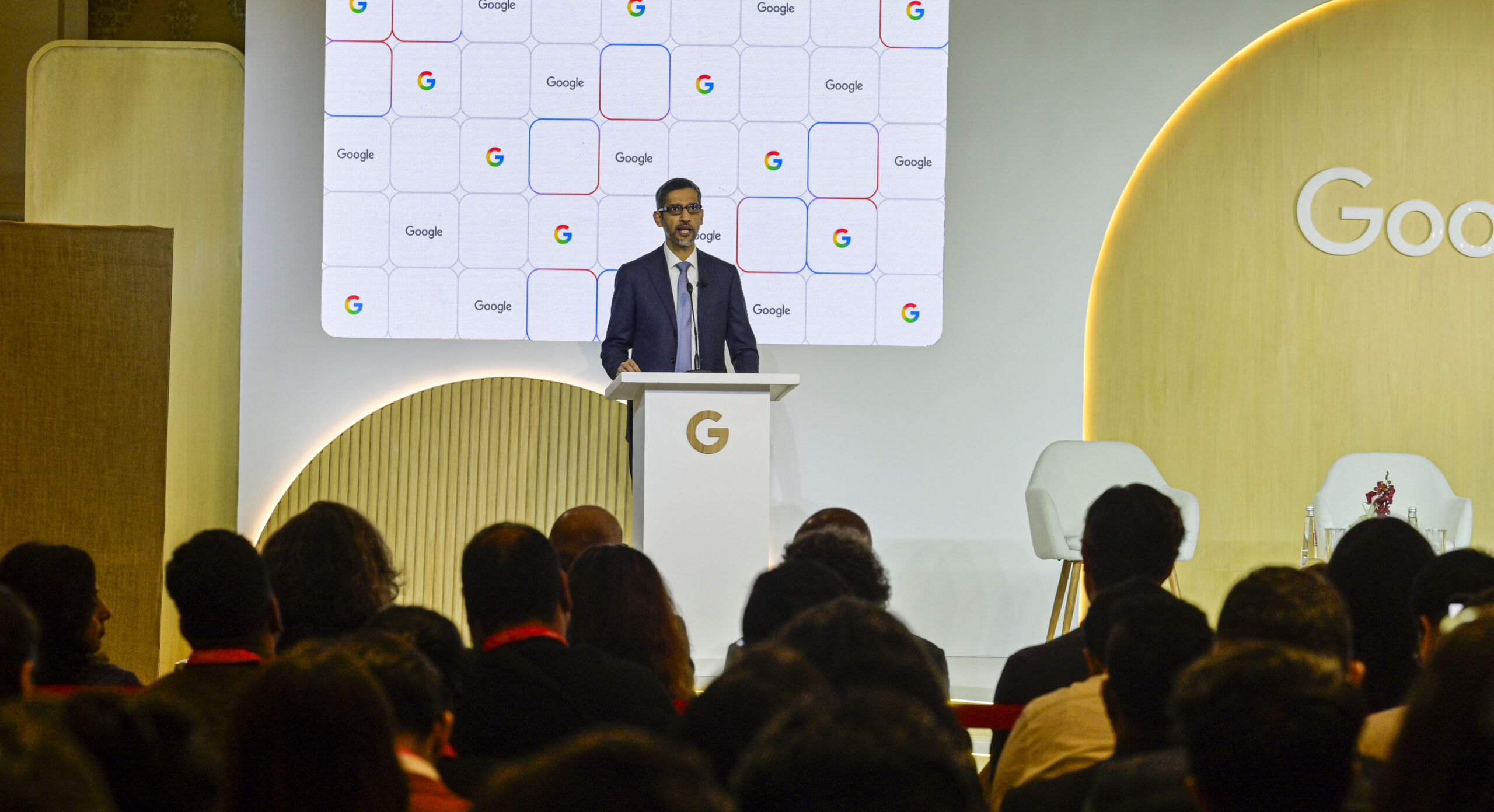
Summary: The Daily Upside reports that Alphabet's second-quarter sales rose 24%, search revenue climbed 17%, and AI-boosted cloud revenue jumped more than 80%, while quarterly capital spending tracked at about $45 billion. The company has signaled as much as $190 billion in capex this year, and the article says major hyperscalers are expected to spend more than $750 billion collectively. Google is trying to counter cost pressure with lighter Gemini variants, including Gemini 3.6 Flash, Gemini 3.5 Flash-Lite, and a cybersecurity-focused Flash Cyber model. The strategic tension is clear: Google needs lower-cost inference to defend usage, but the AI buildout still has to justify an enormous physical infrastructure base.
Ideation
Sell factories and unions a consent, payment, and provenance system for turning worker demonstrations into legally usable robot training data. The company is not another robot-data marketplace. It is the trust layer that lets a manufacturer collect high-value task data from real production work without turning every line worker, works council, and privacy officer into a blocker.
Source Signals
- Tesla to train Optimus with employees at Gruenheide plant via TLDR
Selected Tesla employees will demonstrate daily assembly tasks for Optimus training, while mass deployment timing remains unclear. - Travis Kalanick just raised $1.7B for Atoms via TLDR
Large capital is moving into physical automation across food production, mining, and transportation. - Collecting robot training data is dirty, unglamorous work via Web verification
Prior art confirms robot data collection is already funded; the open gap is deployment-grade rights and provenance, not raw capture.
Why Now: Humanoid and industrial-robot funding has moved from demos into field data. The scarce asset is not a generic video of a human doing a task; it is a consented, timestamped, role-aware demonstration from the exact workcell a robot may enter. EU labor rules, works councils, safety liability, and worker replacement anxiety make informal capture brittle.
First Wedge: A factory-floor data collection kit for one high-turnover task family such as kitting, inspection, or line-side material handling. It records demos, strips unnecessary identity signals, maps each clip to task steps and safety constraints, manages worker consent, and pays per accepted demonstration or downstream reuse.
Commercial Model: Manufacturers and robotics integrators pay a setup fee plus per-seat or per-workcell licensing. A share of dataset revenue or deployment savings funds worker payments, which gives unions a reason to accept the system instead of treating it as surveillance.
Defensibility: The moat is a rights-cleared task graph tied to real equipment, error modes, worker roles, and deployment outcomes. A robot lab can buy motion capture, but it cannot easily recreate years of consent records, workcell provenance, union templates, and task-specific royalty norms across plants.
Technical Risk: The hard part is proving that privacy-preserved demonstrations still retain enough hand, tool, timing, and environmental detail to improve robot policies. If anonymization destroys manipulation signal, the product collapses into compliance theater.
Market Expansion: Start in automotive assembly, then expand to warehouses, food production, mining maintenance, hospital logistics, and field service tasks where workers know the hidden movements that make automation hard.
Self-Critique: This can fail if manufacturers prefer captive data collection and refuse worker royalties, or if unions reject the premise that automation training can be made acceptable. It also depends on robot companies needing external plant data rather than vertically integrating all data capture.
Next Experiment: In four weeks, sign one pilot with a mid-sized manufacturer and one labor-side advisor. Instrument a single non-sensitive task, produce a consented dataset with provenance metadata, and ask a robotics team whether it is more valuable than ordinary teleop data.
Sell public companies, biotechs, CROs, and exchanges software that detects and prevents misuse of nonpublic information in prediction markets. As event contracts move from elections and sports into FDA decisions, the new primitive is not the market itself; it is a compliance perimeter around tradable facts before those facts become securities-price news.
Source Signals
- Kalshi to offer betting on drug trial results and FDA regulatory decisions via The Daily Upside context
Kalshi is piloting contracts on clinical-trial and FDA outcomes, while critics flag manipulation and insider-trading risk. - Kalshi Bets Election Fever Will Drive Platform Growth via The Daily Upside
Prediction markets are becoming public intelligence feeds, not only trading venues. - Prediction Markets and the Law of Insider Trading via Web verification
Legal analysis says companies should update policies and monitoring because traditional securities controls do not cover event contracts well.
Why Now: Prediction markets are crossing into milestones where many non-executives have useful private information: clinical coordinators, CRO staff, statisticians, FDA-facing regulatory teams, IR agencies, and vendors. Existing compliance stacks watch broker accounts and company securities; they usually do not know which event contracts map to which internal secrets.
First Wedge: A biotech MNPI map that links trials, endpoints, FDA calendars, advisory committees, press drafts, and contractor access lists to live event-market contracts. It generates employee restrictions, certifications, suspicious-trade alerts, and audit packets for counsel.
Commercial Model: Public biotechs and CROs pay annual compliance subscriptions based on trial count and employee/contractor population. Prediction-market venues can also pay for issuer-grade attestations and cleaner market surveillance.
Defensibility: The company compounds a contract-to-MNPI ontology: which events map to which companies, employees, vendors, documents, geographies, and disclosure windows. Generic GRC tools lack the event-market data model, while exchanges lack issuer-side access context.
Technical Risk: The hard part is entity resolution and signal quality. The system must map messy market wording to actual confidential workflows without flooding legal teams with weak alerts or implying surveillance of personal accounts where the employer lacks rights.
Market Expansion: After biotech, move into defense awards, energy permits, litigation outcomes, labor actions, election operations, and supply-chain events where tradable outcomes intersect with distributed confidential knowledge.
Self-Critique: The market may be too early if event contracts remain legally constrained or if companies simply ban employee accounts and move on. Buyer urgency depends on visible scandals or exchange requirements forcing boards to treat prediction markets as a real control surface.
Next Experiment: Build a manual concierge version for ten public biotechs: map their top five marketable events, draft policy updates, monitor listed contracts for 30 days, and test whether general counsel or compliance signs a paid pilot.
Sell generic-drug makers a regulatory evidence engine for moving a product from an overseas plant to a U.S. manufacturing path without losing bioequivalence, quality, or margin. The primitive is a living transfer twin: formulation, API source, process parameters, facility readiness, and ANDA evidence tied together before a tariff or shortage forces a rushed move.
Source Signals
- Trump's 100% Tariffs on Generic Meds Threaten Headaches at Drugstore Checkouts via The Daily Upside
The newsletter reported a proposed 2028 tariff schedule on imported generics and the margin pressure facing Indian and European manufacturers. - FDA Actions to Support and Strengthen Domestic Drug Manufacturing via Web verification
FDA describes PreCheck and an ANDA prioritization pilot for domestic generic manufacturing, U.S. bioequivalence testing, and U.S.-sourced APIs. - Shares in Generic-Drug Makers Fall After Trump's Tariff Plan via Web verification
Market reaction suggests investors see real risk, while industry sources argue reshoring is economically difficult for low-margin generics.
Why Now: The policy window is long enough to act but short enough to create budget. Generics are low-margin, highly regulated, and supply-chain-fragile; reshoring cannot be solved by announcing a factory. Each product needs a defensible path through API sourcing, process transfer, stability, inspection readiness, and bioequivalence evidence.
First Wedge: Start with a tariff-exposure and transfer-readiness product for 20 high-volume oral solid generics. It ingests ANDA history, process data, supplier certificates, batch records, and facility constraints, then produces a ranked transfer plan and FDA-facing evidence checklist.
Commercial Model: Generic manufacturers, hospital purchasing coalitions, and CDMOs pay per portfolio plus success fees for products accepted into priority-review or domestic supply programs. The budget exists because a failed transfer can erase the economics of an entire product line.
Defensibility: The system gets stronger with each transfer because it learns which process changes, API substitutions, and facility gaps actually trigger review delays or bioequivalence failures. Incumbent QMS and ERP systems store records; they do not reason across product economics, manufacturing science, and regulator-ready evidence.
Technical Risk: The hard part is trustworthy prediction from sparse, proprietary, and messy pharma data. If the twin cannot explain why a formulation or API change is likely to fail, regulatory and quality teams will not rely on it.
Market Expansion: Move from oral solids into injectables, sterile fill-finish, medical countermeasures, shortage-prone hospital drugs, and eventually insurer or government purchasing models that pay for verified domestic resilience.
Self-Critique: This could become a services-heavy regulatory consultancy if the software cannot standardize enough of the evidence workflow. It also depends on policy pressure persisting and on manufacturers sharing enough process data to make predictions useful.
Next Experiment: Interview ten generic manufacturing executives and three former FDA CMC reviewers. For one off-patent drug, build a hand-assembled transfer twin and test whether it changes a real make/buy/onshore decision.