World
1 critical / 0 happenings
Pre-read: Section 301 is becoming the Trump administration's legally sturdier replacement for broader tariff tools that courts have narrowed. USTR's June determination says 60 economies failed to impose or enforce forced-labor import prohibitions and proposes 10% or 12.5% additional duties. Reuters' newsletter is useful because it shows how that legal architecture is now spreading from labor claims into country-specific and sector-specific pressure.
Summary: Reuters frames the current tariff push as an attempt to rebuild Trump's import-tax arsenal on a more durable legal base. Brazil was hit first with a new 25% U.S. tariff on goods including farm machinery, wood products, ethanol, and apparel, even though the U.S. runs a trade surplus with Brazil. Washington argues the move answers unfair trade practices and illegal deforestation; President Luiz Inacio Lula da Silva called it unjustified.
The broader mechanism is a stack of Section 301 cases. Reuters says forced-labor accusations could cover around 60 countries, while another overcapacity track could target 16 major trading partners including China, the EU, Japan, South Korea, Mexico, and Vietnam. The administration has also opened a Germany pharmaceutical-pricing probe and threatened tariffs over digital-services taxes. The fiscal backdrop matters: Reuters says refunds of invalidated earlier tariffs pushed the June budget deficit to $120 billion, making tariff revenue part of the political economy rather than a side effect.
 3-2-1: On leisure vs. luxury, unlocking growth, and the many versions of a good life
James Clear's note is a compact life-design reset: achievement is satisfying, but the real target may be a life you enjoy rather than a specific credential, promotion, or status object. The strongest idea is the distinction between removing vices and releasing comforts; the former cleans up behavior, while the latter creates room for larger growth. It is worth opening if you want a short prompt about leisure, novelty, and loosening the story that only one version of success can make you happy.
Tech
1 critical / 2 happenings
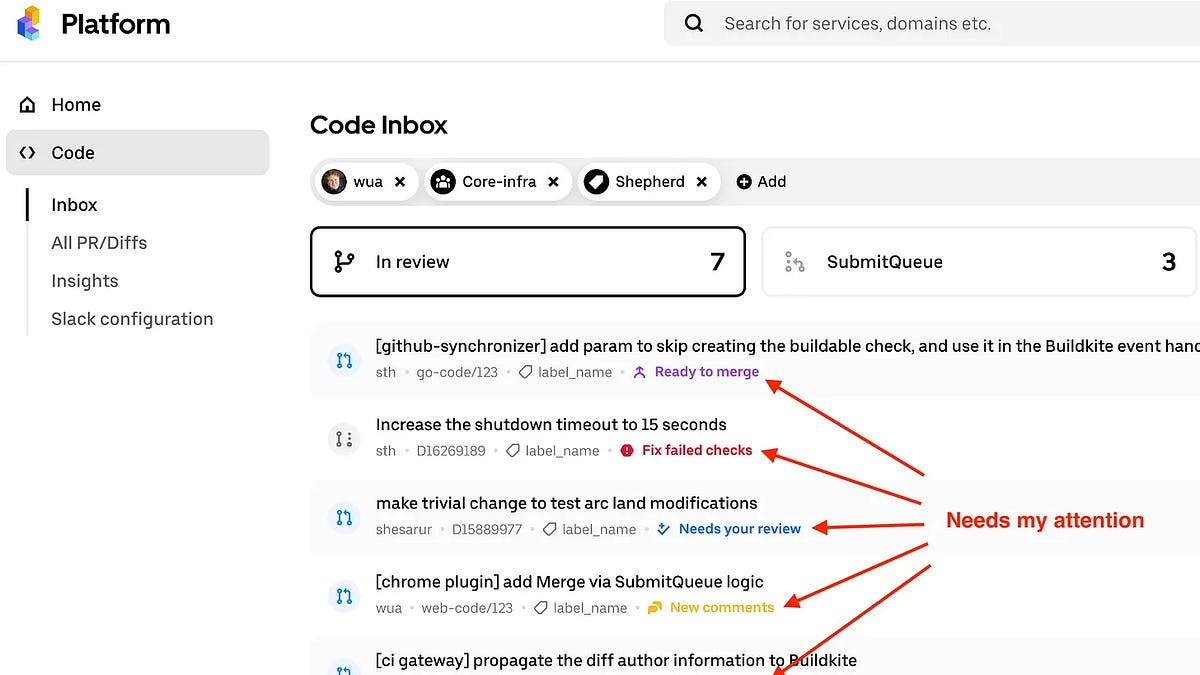 The Pulse: New trend - concern about massive increase in code review load
Pre-read: AI coding has moved the scarce resource from typing speed to review bandwidth. The outside evidence now points in the same direction: Codacy cites CircleCI 2026 data showing feature-branch throughput rising while main-branch throughput fell for the median team, and Pragmatic Engineer survey work already found builders feeling the review burden most sharply. The article is worth opening because it turns that diffuse pain into a concrete map of tools, in-house experiments, and unresolved verification work.
Summary: Gergely Orosz reports that engineering leaders are increasingly worried about code review load as stronger coding agents produce more and better diffs. The market reaction has been a burst of AI review tools, including CodeRabbit, Greptile, Qodo, SonarQube/Gitar, Claude Code review, Cursor review, GitHub Copilot review, Sentry Seer, and Linear reviews. Large companies are also building internal systems: Uber's Code Inbox includes smart assignment and risk profiling, while Cloudflare, Faire, HubSpot, and others have built custom review flows because vendor integrations were not enough.
The sharper point is that review is an inadequate frame for the next bottleneck. Orosz says teams are asking how to verify code through tests, fuzzing, formal methods, observability, and test-quality checks, while engineers report review fatigue and shallow approvals when AI comments look clean. The practical takeaway is that the durable tool wedge is proof and runtime evidence, not another PR-comment generator.
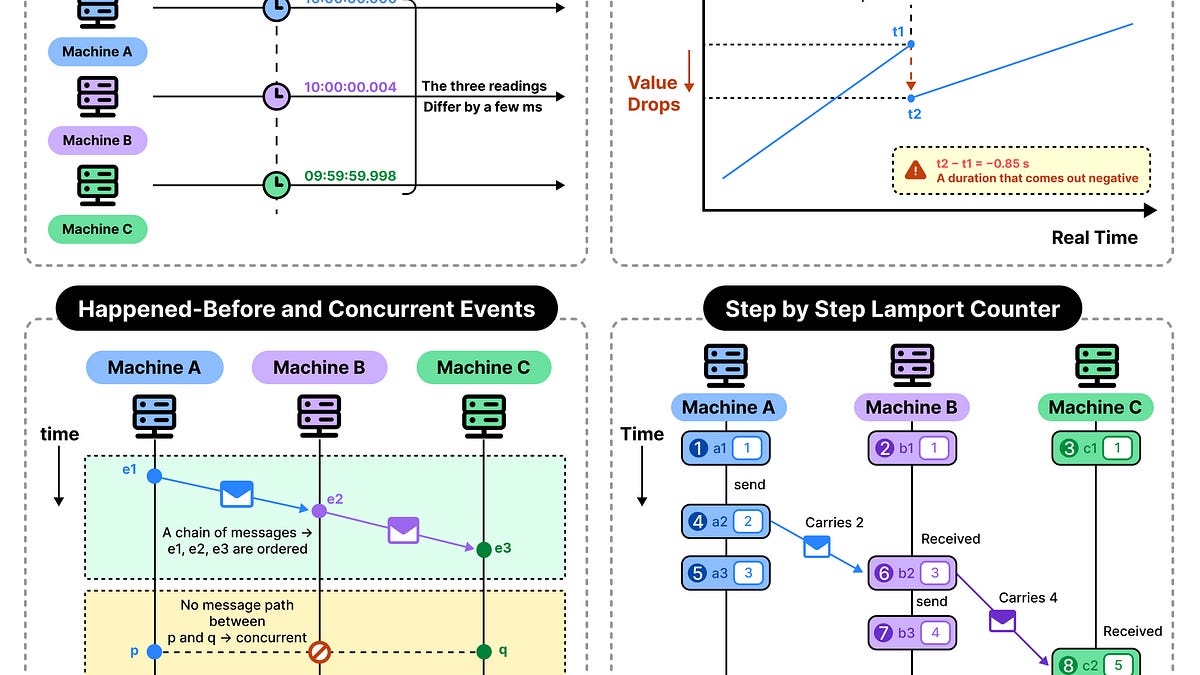 Distributed clocks stay operationally unforgiving
Pre-read: Multi-region systems turn time into a correctness boundary, not a logging convenience. YugabyteDB's clock-sync writeup explains why TrueTime-like systems need specialized infrastructure and why hybrid logical clocks became a deployable compromise.
Summary: ByteByteGo explains why distributed systems cannot safely use ordinary machine timestamps to decide what happened first. Hardware clocks drift, NTP narrows but does not eliminate skew, and timestamp comparisons can discard newer writes, scramble logs, or authorize actions from stale state. The post walks through happened-before relationships, logical clocks, vector clocks, hybrid logical clocks, and Spanner's approach to global ordering. Its practical value is the reminder that causality is a data structure. Systems that need reliable audit, replication, debugging, or agent-action provenance need explicit ordering machinery rather than faith in wall-clock time.
 DMARC becomes a sharper standard
Pre-read: Email authentication is infrastructure strategy for anyone sending product, agent, or transaction mail. The important external fact is that RFC 9989 moved core DMARC onto the Standards Track in May 2026 and obsoleted the earlier informational RFCs.
Summary: Resend's guide explains the operational changes in the new DMARC family: core DMARC is now RFC 9989, aggregate reporting is RFC 9990, and failure reporting is RFC 9991. Existing records keep working, but receivers now have a DNS Tree Walk method for discovering the organizational domain instead of relying on the Public Suffix List. The old pct rollout tag is gone, replaced by a simpler testing flag, while np lets domain owners set policy for non-existent subdomains. For builders, the actionable move is narrow: remove stale fractional rollout assumptions, consider np=reject for spoofed subdomains, and keep reading aggregate reports before moving to enforcement.
Ideation
Sell security and platform teams a merge gate that proves what an AI-authored change can affect before it ships. The product builds a causal graph across the ticket, prompt, files touched, tests, feature flags, deploys, traces, ownership, and past incidents, then asks for specific evidence instead of another broad code review. The new primitive is a proof bundle for software changes: not who wrote the code, but what chain of effects the company is willing to trust.
Source Signals
- The Pulse: concern about massive increase in code review load via The Pragmatic Engineer
The newsletter frames review as the new bottleneck after AI made code generation cheaper, and notes that many teams are experimenting with review bots and in-house systems. - A Beginner's Guide to Clocks, Causality, and Ordering in Distributed Systems via ByteByteGo
The causality piece is a useful metaphor and mechanism: correctness depends on knowing what happened before what, not just comparing timestamps or isolated events. - Best Code Review Tools 2026: 8 AI Code Review Tools Compared via Web verification
The category is crowded with PR-comment tools, so a generic AI reviewer is consensus. The wedge has to be proof and provenance for high-risk changes. - Vibe Coding Security Debt: AI-Generated Vulnerabilities at Scale via Cloud Security Alliance
The research note supports treating AI-generated code as unverified input, which points toward assurance infrastructure rather than reviewer replacement.
Why Now
Coding agents are making pull requests cheaper than senior attention. At the same time, the obvious response, AI code review, is already crowded and easy to add to existing developer tools. The harder unsolved job is deciding which changes need proof, what proof is enough, and how to preserve an audit trail when autonomous agents modify systems that already have production history.
First Wedge
A GitHub/GitLab merge gate for fintech, healthcare, infrastructure, and B2B SaaS teams that flags AI-authored or agent-assisted PRs touching high-risk codepaths. For each PR, it produces a required evidence checklist: affected services, owners, invariants, tests that must run, production traces to compare, rollout limits, and rollback triggers.
Commercial Model
The buyer is the head of platform, AppSec, or engineering productivity at companies already paying for SAST, CI, observability, and AI coding seats. Price by active repo plus high-risk PR volume, starting as a $25k-$75k annual team product and expanding into governance reporting for regulated software teams.
Defensibility
The compounding asset is the causal map between code structure, runtime behavior, ownership, incidents, tests, and deploy outcomes. A PR bot can copy comments; it cannot easily copy a customer's accumulated proof history and policy decisions across thousands of merges. Incumbents can add pieces, but most are anchored in one surface: code review, CI, observability, or security scanning. The wedge is the connective tissue between them.
Technical Risk
The hard part is producing low-noise causal claims. Static dependency graphs over-warn, traces are incomplete, tests lie about coverage, and agents may omit the prompt or context that caused a change. Version one should avoid claiming full correctness and instead prove narrower things: changed payment authorization path, missing regression evidence, unowned service dependency, risky flag rollout, or unmatched production trace.
Market Expansion
Start with AI-authored code gates, then expand into general change assurance for migrations, dependency upgrades, infrastructure-as-code changes, incident remediations, and eventually autonomous rollback approval. The same causal proof bundle could become the audit object for any machine-made operational change.
Self-Critique
This can die by becoming yet another noisy enterprise gate. If teams see it as slower code review with a fancier graph, they will bypass it. It also needs deep integrations before it feels magical, which makes sales and onboarding heavy. The narrow wedge has to be one painful workflow where false positives are tolerable because the cost of a bad merge is clearly higher.
Next Experiment
In two weeks, instrument 200 recent PRs from three AI-heavy engineering teams. For each merged PR, build a lightweight causal bundle from git metadata, CODEOWNERS, CI, test names, incidents, deploy records, and traces. Ask staff engineers to rank whether the bundle would have changed their review decision. Success is not perfect bug catching; it is a 30% reduction in reviewer uncertainty on high-risk PRs without increasing review time.