World
0 critical / 1 happenings
Pre-read: Midterm economic politics usually turn on lived affordability, not headline resilience. Tariffs, immigration enforcement, energy shocks, and supply-chain risk can leave GDP and markets intact while keeping households skeptical. Reuters is useful here because it turns that gap into a data check rather than a vibes argument.
Summary: Reuters' One Essential Read says Trump's first 18 months back in office have produced a resilient but unsettled economy shaped largely by his own policy shocks. The newsletter points to tariff hikes, immigration crackdowns, and an unexpected Iran war that lifted oil prices and added supply-chain risk. It says the economy has held up better than many economists expected, but Trump's promises of lower prices, more factory jobs, and easier middle-class conditions have not materialized.
The political implication is timing. With the midterms just over three months away, the administration is trying to sell strength while voters are still judging prices, jobs, and household pressure. The article's value is less a single data point than a scorecard: policy volatility has not broken the economy, but it has not yet delivered the promised distributional payoff.
Tech
1 critical / 0 happenings
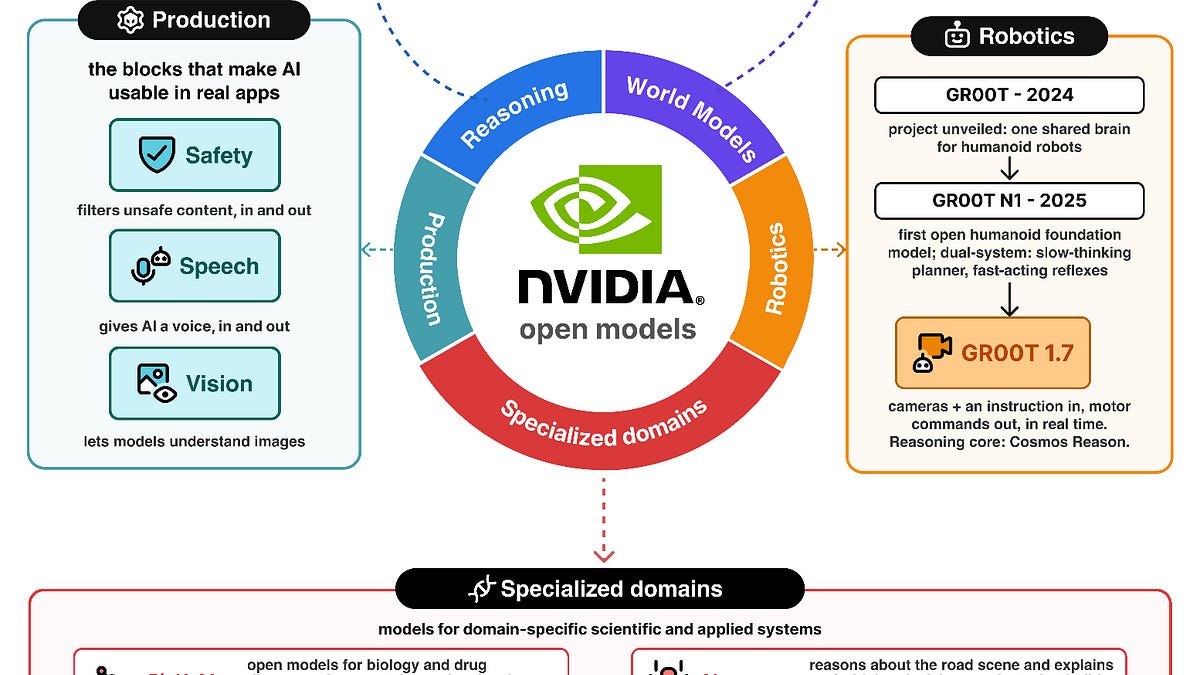 How NVIDIA Builds Open Models for the Age of AI
Pre-read: Physical AI is shifting from demo-driven robotics to reusable model infrastructure: NVIDIA describes Cosmos as an open world-foundation platform for reasoning, closed-loop simulation, synthetic data, and robot-policy learning, while GR00T pushes the same stack toward humanoid control. The strategic hinge is that a chip company can make software openness serve hardware demand when the models, data, recipes, and evaluation loops pull more developers onto its compute. This piece is worth opening because it explains the operating logic behind that flywheel from inside NVIDIA's model program.
Summary: ByteByteGo's interview with Bryan Catanzaro frames NVIDIA's open-model portfolio as one system spanning Nemotron reasoning models, Cosmos world models, GR00T humanoid policies, Alpamayo for self-driving, BioNeMo for life sciences, Ising for quantum, and Earth-2 for climate. The useful takeaway is architectural: NVIDIA leans on hybrid Mamba/attention designs, MoE layers, and Blackwell-aware low-precision training so speed compounds into cheaper pretraining, larger context, longer inference, and more reinforcement-learning rollouts.
The stronger strategic point is organizational. NVIDIA is reusing shared foundations across language, video, robotics, AVs, and biology instead of staffing isolated model efforts. Catanzaro argues that open means weights plus data, tools, training recipes, papers, and reproducible environments; that matches NVIDIA's public positioning of Cosmos as open models plus data-processing, training, and evaluation frameworks. The business case is clean: open models let developers customize on NVIDIA's stack, expose future hardware needs earlier, and make compute demand grow outside NVIDIA's own applications.
Ideation
This company sells evidence packs that let a warehouse, factory, hospital, or insurer approve a new robot policy without pretending a one-time robot certification covers every model update. The primitive is a model-version safety case: simulation traces, real fleet telemetry, near-miss clips, operator overrides, and standards mappings compiled into a tamper-evident dossier for a specific robot body, site layout, task, and policy version.
Source Signals
- How NVIDIA Builds Open Models for the Age of AI via ByteByteGo
NVIDIA's open physical-AI stack points toward frequent robot model and data releases, not slow fixed software. - Isaac GR00T - Generalist Robot 00 Technology via NVIDIA
GR00T is positioned as a platform for robot foundation models and data pipelines. - How to Evaluate General-Purpose Robot Policies for Real-World Deployment via NVIDIA
Generalist robot policies need long-tail evaluation across tasks and embodiments; no one lab has all the data. - Consumer and Commercial Robots via UL Solutions
Robot certification already exists, which makes the wedge evidence generation for changing policies, not becoming another certifier. - API Underwriting: A Perfect Solution for AVs & Robotics Insurance via Koop
Insurance telemetry is already a known ask, so the sharper angle is model-version-aware, incident-grade safety evidence.
Why Now
Open robot policies, world simulators, and synthetic data make deployment faster than the safety process around it. A facilities VP can buy robots this year, but every model update creates a new question from legal, insurance, and workers' comp: what changed, where was it tested, and what happens near people?
First Wedge
Start with autonomous mobile robots and mobile manipulators in warehouses. Pull logs from one fleet, replay high-risk events in simulation, map traces to ISO/ANSI safety requirements, and produce a monthly safety-case diff for the operator's insurer and internal safety lead.
Commercial Model
Warehouse operators and robot OEMs pay $3K-$15K per site per month, with higher-priced incident reconstruction when there is a claim or serious near miss. The budget exists because insurance premiums, customer audits, and worker-safety approvals can delay fleet expansion.
Defensibility
The company compounds a cross-OEM library of near-miss patterns, site morphology, task traces, and insurer-accepted evidence templates. Incumbents can certify hardware, and OEMs can log their own robots, but neither is naturally trusted as a neutral witness across mixed fleets and changing third-party policies.
Technical Risk
The hard part is making heterogeneous robot telemetry, simulation traces, and video evidence comparable enough that a safety reviewer trusts the output. False comfort is worse than no tool; the product needs calibrated uncertainty and clear boundaries.
Market Expansion
After warehouses, expand to hospitals, airports, retail floors, construction sites, farms, and defense logistics - any site where robots share space with people and where the buyer needs proof that a policy update did not silently change the risk profile.
Self-Critique
This could be too early if robot deployments remain pilots and insurers do not price safety evidence explicitly. It also risks becoming compliance consulting unless the telemetry connectors and evidence templates become repeatable software.
Next Experiment
In four weeks, partner with one AMR integrator and one broker. Reconstruct ten near-miss events from logs and video, generate a policy-version safety diff, and ask the broker which fields would change underwriting confidence or premium language.
This company sells a credit-grade map of AI infrastructure exposure: which data centers are real, which power contracts and interconnect queues back them, which chip leases or take-or-pay commitments sit underneath them, and which public companies or private-credit vehicles are economically tied to the same project. The primitive is not a data-center database; it is a physical exposure graph for the AI buildout.
Source Signals
- Coping with Capex via The Daily Upside
The newsletter framed AI capex as a credit-quality issue for hyperscalers, Oracle, CoreWeave, and investors. - Credit Risk Insights for Global Data Centers via Moody's
Moody's tracks data-center risk across leverage, leases, securitizations, project finance, and local governments. - Private Markets Are Expected to Have a Growing Role in Data Center Financing via Goldman Sachs
Private-market financing is becoming central to the AI data-center buildout. - Roadmap: The AI Data Center Stack via Bessemer Venture Partners
The generic data-center stack is already consensus; the wedge has to be credit exposure and independent verification. - Shein's Hong Kong IPO filing sidesteps Xinjiang cotton controversy via Reuters
Capital markets increasingly punish weak physical-world provenance and regulatory opacity.
Why Now
The AI trade is becoming a financing trade. Capex, leases, power, local incentives, and credit structures now matter as much as model benchmarks, while many investors still rely on earnings-call language and generic data-center market maps.
First Wedge
Sell to credit funds and bond desks a weekly verified watchlist for the top 100 AI infrastructure obligations: site status, power availability, permitting, counterparties, lease economics, debt stack, covenant changes, and contradictory public claims.
Commercial Model
Private-credit funds, infrastructure lenders, insurers, and rating-adjacent research teams pay $50K-$250K per year per seat group. The buyer already pays for Bloomberg, rating research, satellite data, legal review, and specialist channel checks because one bad exposure can erase years of subscription cost.
Defensibility
The system compounds proprietary mappings between public filings, utility queues, satellite/construction signals, permit records, equipment supply chains, and financing vehicles. Incumbent financial terminals have distribution, but they usually lag on messy physical verification; construction data vendors lack the credit graph.
Technical Risk
The hard problem is entity resolution across shell project companies, landlord-tenant leases, utility filings, equipment vendors, and private-credit vehicles. The product must show confidence levels and source trails rather than producing a single fake-precise exposure number.
Market Expansion
Start with AI data centers, then expand into semiconductor fabs, battery plants, defense factories, and climate infrastructure where capital-market risk depends on physical buildout, power, permitting, and hidden counterparty concentration.
Self-Critique
This can fail if the best data remains locked inside banks, rating agencies, or utilities, or if customers treat it as nice-to-have research rather than trading and underwriting infrastructure. It also faces strong incumbents if the product is only a prettier market map.
Next Experiment
In two weeks, build one exposure graph around Oracle/CoreWeave and one around a hyperscaler-backed power project using only filings, permits, utility dockets, satellite imagery, and news. Put it in front of three credit investors and ask what they would have paid to know earlier.