World
1 critical / 2 happenings
Pahlavi's faltering bid to lead Iran
Pre-read: Exile politics often looks powerful from Washington because it compresses a fractured domestic society into a legible opposition brand. Iran's monarchy nostalgia, diaspora fundraising, street-level anger, and foreign-policy incentives point in different directions. Reuters' piece is worth opening because it tests a claimant to power against organization, discipline, and US support.
Summary: Reuters' special report says Reza Pahlavi, son of Iran's last shah, is pitching himself as a bridge to a democratic future while arguing that the Islamic Republic is near collapse. The reporting describes a movement that peaked publicly around a CPAC appearance, then ran into donor discontent, violence by some supporters, and rejection from the Trump administration. That combination weakens the simple "exile leader returns" story. The useful model is institutional: opposition legitimacy does not come from name recognition alone. It requires coalition control, credible inside-country networks, disciplined supporters, and foreign backers willing to absorb the risks of regime-transition politics.
Pre-read: Middle East ceasefire signaling often runs through parallel channels: public optimism, military tests, proxy ambiguity, and domestic coalition management. The Strait of Hormuz remains a pressure point because energy markets react to risk even before shipping lanes close.
Summary: Reuters says President Trump described US-Iran contacts as "good talks," while Iran appeared to test the pause as Saudi Arabia, Jordan, and Iraq reported drone attacks. Reuters also reported that only about one in three Americans supported the Iran war, the lowest Reuters/Ipsos reading since the conflict's early phase, with most respondents saying Trump had not explained his goals. The operational picture is unstable: diplomacy is active, regional actors are still absorbing attacks, and domestic US support is soft. That makes escalation control as much a political-communications problem as a military one.
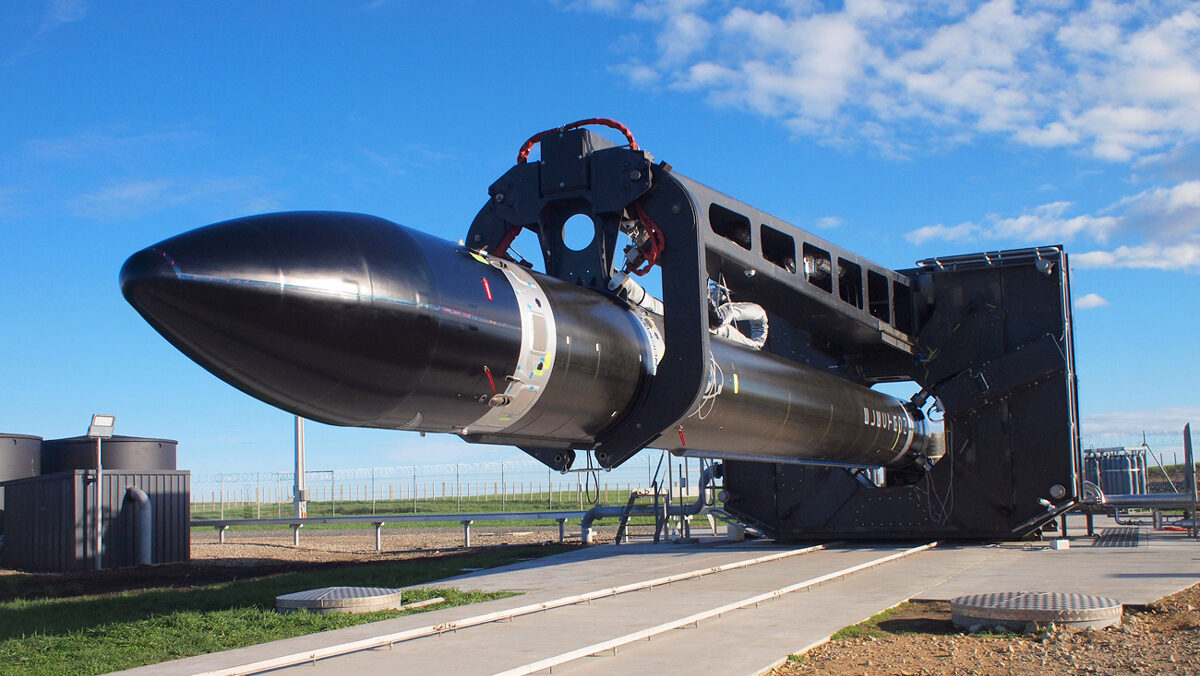 Rocket Lab sells defense responsiveness
Pre-read: Space procurement is shifting from exquisite one-off assets toward responsive launch, proliferated constellations, and redundancy under military stress. That gives smaller launch companies a path to relevance when the buyer values tempo and diversity instead of lowest unit cost alone.
Summary: The Daily Upside reports that Rocket Lab won a $266 million US Space Force contract for launch services and spacecraft tied to missile-defense missions. The deal covers at least 12 suborbital launches, with the first planned later this year, and leaves room for another half-dozen. Rocket Lab's first-quarter backlog was $2.2 billion, already doubled year over year, mostly from public-sector work. The company also reached $200 million in quarterly revenue for the first time, up 64% year over year, while narrowing its loss to $45 million. The strategic read is that government demand can anchor a second-tier space prime even while SpaceX dominates investor attention.
Tech
2 critical / 2 happenings
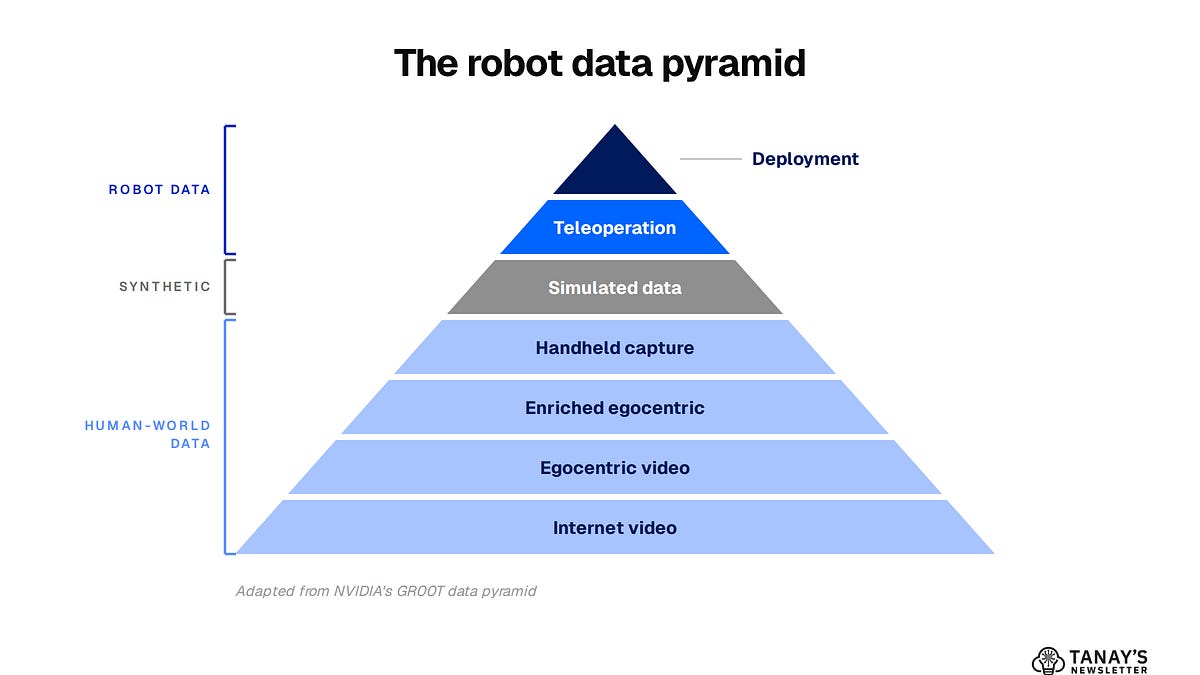 The Data Pyramid in Robotics
Pre-read: Robotics is still missing the equivalent of the public web corpus that made language-model scaling feel straightforward. The field has plenty of demos, but deployable autonomy depends on rare failure cases, contact-rich interaction data, and cross-embodiment transfer, which efforts like Open X-Embodiment only partially standardize. This piece is useful because it sorts the data problem by leverage, not hype.
Summary: Tanay Jaipuria argues that physical AI needs a layered data pyramid rather than a single giant dataset. Low-cost weak signals, simulation, teleoperation, expert demonstrations, and deployment failures each teach different parts of the stack. The highest-volume data is often least specific, while the most valuable failures are scarce, expensive, and tightly tied to real environments. The useful takeaway is that robotics data strategy should be designed around marginal training value: broad coverage builds priors, but field failures and task-specific traces may dominate the last mile.
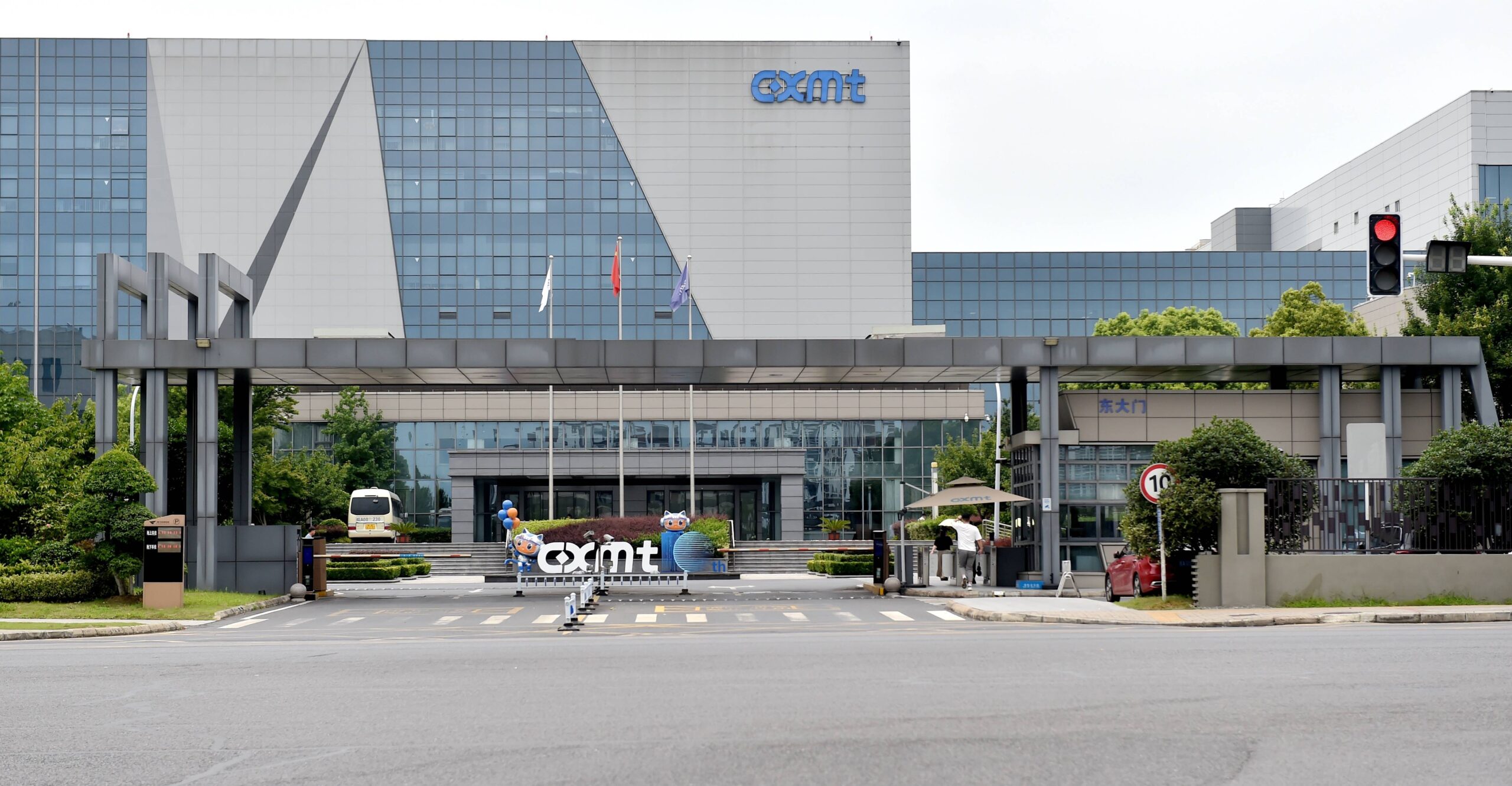 China's Making Memory with its New Biggest Company
Pre-read: AI infrastructure economics are increasingly constrained by memory bandwidth and supply, not just GPU availability. HBM sits near the high end of that constraint, but commodity DRAM shortages still flow into PCs, phones, and data-center buildouts. CXMT matters because China is trying to turn a bottleneck into domestic industrial leverage.
Summary: The Daily Upside reports that Changxin Technology Group soared 466% in its Shanghai STAR Market debut, raised $8.6 billion, and briefly became China's most valuable publicly listed company. The company plans to use the proceeds to expand DRAM production. The article says Samsung, SK Hynix, and Micron control roughly 90% of global DRAM, while CXMT's share is projected to rise from 9% this year to 12% next year. Gartner expects combined DRAM and SSD prices to rise 130% by year-end, lifting PC prices 17% and smartphone prices 13%. The geopolitical catch is direct: CXMT is on a Pentagon blacklist, Micron is arguing against Chinese DRAM access, and device makers want cheaper supply.
 Amazon pushes direct-to-phone satellites
Pre-read: Direct-to-device satellite service is turning mobile coverage into a spectrum, handset, and launch-capacity coordination problem. Apple already pushed the consumer baseline with Emergency SOS via satellite, while Starlink's direct-to-cell work has framed dead zones as an addressable network layer.
Summary: PCMag reports that Amazon plans a 5,105-satellite low-Earth-orbit system for direct voice and mobile data service. The proposed Amazon Leo D2D System would build on Globalstar spectrum in the 1.6/2.4GHz bands after Amazon's reported $11.6 billion Globalstar acquisition. The satellites would orbit roughly 510 km to 580 km above Earth, with first launches expected in 2028. Pricing has not been disclosed. The strategic signal is that Amazon appears to be attacking mobile connectivity from cloud scale, spectrum control, and launch coordination at once.
Pre-read: Export controls on advanced lithography pushed China toward domestic substitution across older but still economically vital chipmaking tools. Immersion DUV cannot replace EUV at the frontier, but it can support a large band of chips where yield, supply assurance, and iteration speed matter.
Summary: Reuters reports that a Shanghai-based company has begun mass production of domestically developed immersion deep-ultraviolet lithography machines. The unnamed firm is targeting about five DUV machines this year and roughly 20 next year, while production remains early. The story matters because DUV tools are less advanced than ASML's EUV systems, but they still support important semiconductor nodes. If China can scale usable domestic DUV capacity, sanctions become less binary: frontier chips remain constrained, while a broader domestic equipment base improves resilience for mature and near-advanced manufacturing.
Ideation
Sell lenders, insurers, and power counterparties an independent telemetry layer that proves an AI data center is actually becoming usable compute, not just financed square footage. The primitive is a covenant feed for compute: power-interconnect progress, chip delivery, memory constraints, customer concentration, utilization, heat, and GPU resale exposure turned into triggers a credit committee can underwrite.
Source Signals
- OpenAI Close to Landing $500 Billion Data Center With Nvidia's Backing via TLDR
The newsletter described a giant AI data-center lease with a possible Nvidia backstop, a structure where the lender's real risk is opaque operating demand and vendor circularity. - DRAM Right That's Expensive via The Daily Upside
AI capex anxiety and memory price pressure make the useful-compute bottleneck broader than GPUs. - SpaceX Rival Rocket Lab Scores Record Contract via The Daily Upside
Government buyers are rewarding redundant strategic infrastructure, which is a useful prior for how AI infrastructure risk may be monitored.
Why Now: AI buildouts are large enough that ordinary SaaS-style diligence does not work. The underwriting question is no longer whether a tenant is famous; it is whether power, chips, networking, memory, customers, and model revenue mature on the same schedule.
First Wedge: A monitoring package for private-credit funds financing a single AI data-center campus: monthly third-party attestations, anomaly flags, and default-risk triggers tied to telemetry from utilities, EPC contractors, colocation operators, chip brokers, and cloud billing.
Commercial Model: Private-credit funds, insurers, power offtakers, and municipal development authorities pay per financed project, with a setup fee plus basis-point-style annual monitoring. The budget exists because a bad project can impair hundreds of millions before utilization data is visible in financial statements.
Defensibility: The data moat is cross-project benchmarks: how long real power approvals take, which equipment shortages slip schedules, which tenant contracts correlate with actual utilization, and how chip resale floors move under stress. Incumbent rating agencies can write reports, but they do not usually own live telemetry integrations.
Technical Risk: The hard part is normalizing messy operational evidence into auditable, low-liability signals without pretending to forecast AI demand. The product must be conservative enough for credit committees and still fresh enough to catch drift before covenants are breached.
Market Expansion: Start with AI data centers, then expand to grid-scale batteries, satellite ground infrastructure, advanced manufacturing plants, and defense production lines where financing risk depends on physical milestones plus opaque demand.
Self-Critique: This could become consulting if counterparties refuse data access or if lenders only want narrative diligence. It also dies if AI infrastructure sponsors keep financing on balance sheet and do not need independent monitors.
Next Experiment: Interview ten project-finance lenders and three power-market lawyers. Build a mock covenant dashboard for one public AI-campus project using only permits, interconnection queues, chip lead-time data, and power-price feeds, then ask whether it would change a credit memo.
Sell warehouses, hospitals, labs, and factories a robot incident recorder that captures near-misses, recovery events, operator interventions, and environmental context across mixed robot fleets. The primitive is not more robot demos; it is failure evidence from real work, packaged for safety review, insurance, vendor accountability, and model improvement.
Source Signals
- The Data Pyramid in Robotics via TLDR
Robotics lacks an internet-scale data substrate, and rare real-world failures may be more valuable than generic demonstrations. - Finding bugs in Raft implementations via TLDR
Cheap compute makes systematic failure search practical in software; embodied systems need the physical analogue. - SpaceX Rival Rocket Lab Scores Record Contract via The Daily Upside
High-consequence buyers pay for operational assurance and evidence, not just capability claims.
Why Now: More robots are entering human spaces, but fleet operators still lack a neutral record of what happened when autonomy failed. Foundation robotics companies need edge cases, insurers need incident evidence, and buyers need a way to compare vendors beyond demos.
First Wedge: A small appliance and cloud workflow for autonomous mobile robots in warehouses: capture synchronized video snippets, robot logs, map state, human intervention, and post-incident labels whenever a safety stop, route failure, manual takeover, or near-collision occurs.
Commercial Model: Warehouse operators and robot vendors pay per site and per robot, with higher-priced compliance exports for insurers and enterprise safety teams. The immediate budget is downtime, worker-safety review, vendor SLA disputes, and insurance documentation.
Defensibility: Every deployment builds a library of failure morphologies across layouts, lighting, floor conditions, human behavior, and robot brands. Vendors can log their own stack, but a neutral recorder wins when buyers run mixed fleets and need evidence that neither vendor controls.
Technical Risk: The core hard thing is detecting meaningful near-misses without drowning operators in false positives, then anonymizing people and site details while preserving enough sensor context to retrain or audit policies.
Market Expansion: After AMRs, move into hospital delivery robots, lab automation, construction robots, field inspection drones, and humanoid pilots. The shared expansion path is environments where autonomy fails in patterned ways and liability matters.
Self-Critique: Robot vendors may resist third-party logging, and many operators may not yet have enough robot density to pay. If regulation stays loose and insurance does not care, the product becomes a nice-to-have analytics dashboard.
Next Experiment: Run a four-week pilot with one warehouse integrator using existing robot logs and ceiling-camera clips. Label 100 intervention events, show three recurring failure types, and test whether the operator will include the recorder in the next vendor rollout.