World
2 critical / 3 happenings
Pre-read: China's low-altitude economy is becoming an industrial-policy testbed for drones, air taxis, logistics, and local aviation services below 1,000 meters. Foreign automakers used to enter China with brand, process discipline, and manufacturing know-how; they now face local rivals with faster engineering loops and tighter government-supply-chain coupling. Flying cars make that shift unusually visible.
Summary: Reuters reports that Volkswagen's China flying-car push, launched after years as the country's top-selling automaker, has stalled while local competitors prepare for liftoff. The piece frames the failure as more than a side-project mistake: it shows how legacy automakers are losing speed in adjacent mobility markets as Chinese companies, local governments, and domestic suppliers coordinate faster. The newsletter excerpt says VW remains grounded while local upstarts advance in drones, air taxis, and low-altitude services. The strategic read is that autonomy and electrification are pulling automakers into policy-shaped hardware ecosystems where brand incumbency matters less than local execution tempo.
Pre-read: Central-bank communication is itself a policy instrument: forward guidance can suppress volatility, while ambiguity forces markets to price uncertainty directly. A chair who wants less signaling is effectively asking bonds to reveal the economy without the usual Fed translation layer.
Summary: The Daily Upside and Reuters both covered the Fed holding rates at 3.5% to 3.75% while Chair Kevin Warsh pledged to deliver 2% inflation and reduce forward guidance. The 30-year Treasury yield hit a 19-year high after the remarks, and the 30-year breakeven inflation measure had its biggest one-day rise since November 2024. Three regional Fed presidents dissented in favor of a hike, the largest one-direction dissent in a decade, according to the Daily Upside. The tension is direct: Warsh wants markets to 'play the ball,' but markets are saying the inflation fight may require tighter policy. June PCE data due today becomes a credibility input, not just another data print.
Pre-read: Regional wars become harder to contain when retaliation moves across borders and hits energy, shipping, and allied basing networks. The Strait of Hormuz and nearby Gulf infrastructure turn each strike into a market and alliance-management event.
Summary: Reuters says the US military struck dozens of Islamic Revolutionary Guard targets in Iran, including command centers and drone facilities, after Tehran fired ballistic missiles at US forces in the Middle East. The Washington Post separately reported that violence widened after Iranian attacks killed a worker in Kuwait and a drone strike hit a US-owned tanker at an Egyptian port. The operational picture points to a conflict spreading through bases, ports, missiles, drones, and energy chokepoints rather than staying inside one bilateral channel.
Pre-read: Air-defense interceptors are now the limiting reagent in several conflicts at once. Industrial capacity, not weapons design alone, decides how long allies can sustain missile defense under drone and ballistic-missile pressure.
Summary: Reuters reported that the US Army awarded Lockheed Martin a contract worth up to $58.6 billion to produce PAC-3 Patriot Missile Segment Enhancement interceptors. The deal comes as Ukraine, Iran-related operations, and allied air-defense demand strain US stockpiles. The contract size shows Washington trying to move from episodic replenishment to durable production capacity, though annual congressional funding still governs how much of that ceiling becomes real output.
 Health-data advertising faces another legal test
Pre-read: Consumer health apps sit at the intersection of advertising optimization and regulated trust. Once sensitive data flows into ad platforms, privacy promises become product architecture claims.
Summary: The FTC, Utah, and California sued Hims & Hers, alleging deceptive and unlawful privacy practices tied to sensitive health information and advertising platforms. The FTC says the company shared consumer health information with third parties including Meta and Snap despite privacy promises; Hims & Hers denies the claims, and the complaint remains an allegation for the court to decide. For AI products that touch health, finance, or identity data, the case is a reminder that provable data boundaries are becoming part of the customer-facing product, not just legal boilerplate.
Tech
2 critical / 3 happenings
 SpaceX looks to compete with the carriers
Pre-read: Low-band spectrum is the scarce substrate for mobile coverage inside cities, buildings, and foliage. Satellite direct-to-cell can fill gaps, but a phone network that feels native still needs terrestrial capacity, regulatory rights, and a capital structure that can absorb years of buildout. Starlink's strategic question is whether space connectivity becomes a carrier add-on or the base layer of a new carrier.
Summary: Semafor reports that SpaceX has been hunting for dense-coverage spectrum, either through acquisitions or a government auction planned for next year. The company has shown investors a prototype mobile handset and has discussed terrestrial networks, while AT&T, Verizon, and T-Mobile already control most low-band US spectrum after spending roughly $110 billion over the last decade. The plan is fluid because towers and spectrum would pull capital away from higher-multiple businesses, especially AI. But SpaceX has cheaper equity than legacy telecom, and Semafor says carrier shares fell after the report. For robotics and autonomous systems, the useful takeaway is that ubiquitous connectivity may become a vertically integrated infrastructure fight, not just a roaming contract.
 DoorDash Is Cleared for Takeoff: Launches DoorDash Air
Pre-read: Drone delivery has moved past the demo phase into the boring constraints that decide whether autonomy becomes infrastructure. The FAA's Part 135 framework makes operators deal with certification, airspace authorization, local land use, environmental review, noise, and community engagement. The hard problem is stitching safe flight into messy merchant operations.
Summary: DoorDash says DoorDash Labs has earned FAA Part 135 air-carrier certification and is launching DoorDash Air as an in-house drone program. The company says it is the eighth drone operator with that certificate and frames the aircraft as only one layer of the system. Its bigger emphasis is ground infrastructure: inventory reconciliation, routing, safety systems, and universal handoffs for drive-throughs, rooftops, and merchant back doors. DoorDash says more than 20% of its 2025 orders traveled three to five miles and took nearly 25% longer than shorter deliveries, a range it sees as attractive for drones. This is a primary-source announcement, so discount the claims appropriately, but the operational map is valuable.
 OpenAI revenue pace keeps accelerating
Pre-read: Frontier AI valuations now depend on revenue velocity and infrastructure credibility moving together. Compute commitments look rational only if paid usage grows fast enough to finance the next training cycle.
Summary: CNBC reported that OpenAI CFO Sarah Friar told employees July annualized recurring revenue exceeded the company's entire second quarter, with growth tied to GPT-5.6, ChatGPT Work, and Codex adoption. The company is under pressure to support an $852 billion valuation and large infrastructure spending plans. The signal is less the exact ARR phrasing than the business cadence: model launches, enterprise packaging, and developer tools are being treated as one monetization engine.
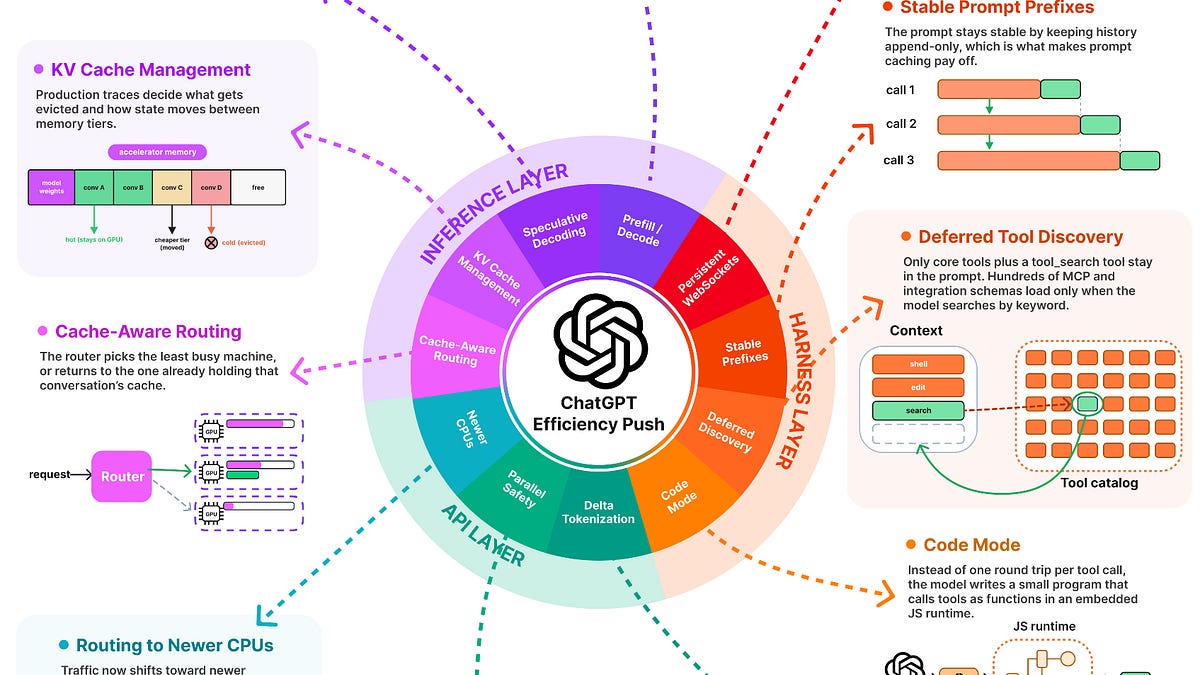 Agent loops are becoming systems engineering
Pre-read: Agent quality is increasingly measured by cost per successful task, not cost per token. Once tools, sandboxes, and memory enter the loop, latency and repeated work become product constraints.
Summary: ByteByteGo's deep dive explains the agent path through harness, API, and inference layers: the harness builds context and executes tools, the API converts model output into events, and the system loops results back into the conversation. The practical optimization theme is familiar distributed-systems work: preserve stable state, avoid rebuilding context, cache where semantics allow it, and measure the full task rather than isolated calls. It is useful for builders because it turns frontier-agent performance into concrete engineering surfaces.
Pre-read: Enterprises will not let autonomous agents touch production systems without audit trails, policy hooks, and post-incident reconstruction. Security controls have to observe intent and action, not only network traffic.
Summary: Perplexity's Numbat repo positions itself as endpoint visibility for AI agent activity, with local detection, optional pre-action blocking, rules, session artifacts, and forensic case bundles. The repo is early and source-controlled rather than reported journalism, so it belongs as a signal rather than a verdict. The durable point is that agent observability is separating into its own tooling layer, adjacent to EDR and developer telemetry.
Ideation
Sell electrical and mechanical subcontractors a field evidence system that turns every installed component, test, failure, fix, and signoff into a reusable commissioning passport. The wedge is not generic construction tracking. It is a live proof package for the last 20% of hyperscale AI data-center builds, where scarce electricians, power gear delays, and integrated systems testing determine when GPUs can actually turn on.
Source Signals
- AI companies are recruiting electricians and carpenters by the thousands via TLDR
The newsletter linked the labor bottleneck underneath AI data-center buildout: hyperscalers and capital providers are funding trade training because compute capacity is constrained by physical work. - Doxel for Data Centers via Prior check
Doxel and Buildots show that generic progress tracking is already a real market, so the sharper wedge is commissioning-grade evidence and rework prevention for MEP handoffs. - A scorecard for the AI age via Current verification
OpenAI's public framing around cost per successful task reinforces the buyer pressure: useful compute only matters once sites are delivered and dependable.
Why Now: AI infrastructure has moved from buying chips to bringing dense power and cooling online fast. The newest scarce resource is not a model engineer; it is the experienced trade crew and commissioning lead who can prove a 100MW site is ready without weeks of manual binders, disputed progress, and repeated walkthroughs.
First Wedge: Start with electrical contractors on hyperscale data-center jobs. Capture QR-tagged equipment, panel photos, torque checks, test results, redlines, issue closeout, and witness signoffs into a turnover package that the owner, GC, commissioning agent, and insurer can trust.
Commercial Model: Electrical and MEP subs pay per project or per megawatt because faster acceptance improves cash collection and reduces liquidated-damage exposure. Owners can later pay portfolio licenses once the passport becomes a standard handoff requirement across sites.
Defensibility: The moat is a component-level evidence graph across similar facilities: which crews, vendors, parts, failure modes, and test sequences actually shorten time to ready-for-service. Procore, Autodesk, Doxel, and Buildots can see progress; this product owns the acceptance evidence and commissioning memory that repeats across AI campuses.
Technical Risk: The hard part is evidence integrity in messy field conditions: matching photos, forms, test instruments, BIM objects, schedule activities, and human signoffs without creating busywork. If capture is not faster than today's paperwork, crews will route around it.
Market Expansion: After data centers, the same passport model expands to battery plants, semiconductor fabs, grid substations, hospitals, and any facility where MEP commissioning, insurance, and regulatory acceptance gate revenue.
Self-Critique: This could collapse into services-heavy construction software if it does not win a narrow signoff workflow. The wedge must be close to money: faster turnover, fewer disputed change orders, and fewer failed integrated systems tests.
Next Experiment: In two weeks, interview five data-center electrical PMs and two commissioning agents, then manually build one passport for a single subsystem, such as UPS startup or switchgear energization. Measure whether it removes a real closeout meeting or accelerates one payment application.
Sell drone operators and large retailers a local approval layer for drone-delivery hubs: a living evidence ledger for noise, privacy, flight paths, operating hours, complaints, mitigations, and promised community benefits. The bet is that the bottleneck for drone delivery will not be only FAA certification or aircraft performance. It will be earning repeatable local permission for nests, rooftops, parking-lot pads, and merchant handoff points.
Source Signals
- DoorDash Is Cleared for Takeoff: Launches DoorDash Air via TLDR
DoorDash says it has Part 135 certification and that the harder problem is the ground infrastructure, routing, safety systems, and merchant handoffs that make drone delivery work at scale. - Package Delivery by Drone (Part 135) via FAA
The FAA makes operators responsible for hub siting, local land-use rules, community engagement, NEPA compliance, and public concerns, including noise and sensitive sites. - Glen Carbon committee splits on Walmart proposal for drone delivery service via Current verification
A local Walmart drone-nest proposal is already running into parking, fencing, variance, noise, and FAA questions at the municipal level. - DougCo towns pump brakes on drone delivery via Current verification
Colorado towns have paused drone-delivery hub applications while they study noise, privacy, zoning, and regulatory uncertainty.
Why Now: Part 135 operators are multiplying, and companies like DoorDash, Walmart, Wing, Zipline, Amazon, and Flytrex are turning pilots into neighborhood infrastructure. At the same time, the FAA leaves hub siting and much community friction to operators and local governments. That creates a repeatable approval workflow before scale.
First Wedge: A paid pre-application package for retailers and drone operators entering a new town: route/noise simulation, hub zoning checklist, resident-impact map, complaint intake, mitigation commitments, and a public dashboard that survives the council meeting.
Commercial Model: Operators pay per proposed hub and then a monthly compliance fee once live. The budget comes from market launch, policy, real estate, and insurance teams because a delayed hub strands aircraft, merchant deals, and local launch marketing.
Defensibility: The compounding asset is municipal outcome data: which flight patterns, hub locations, operating-hour promises, noise envelopes, and complaint responses actually get approved and stay approved. UTM vendors own airspace coordination; this owns ground permission and public trust evidence.
Technical Risk: Noise and privacy models must be specific enough to matter locally without overclaiming precision. The product also has to ingest real telemetry and complaints after launch so it does not become a static permitting deck.
Market Expansion: The same ledger can support sidewalk robots, autonomous shuttles, warehouse yard drones, rooftop charging sites, emergency-response drones, and eventually low-altitude delivery corridors shared by multiple operators.
Self-Critique: Local-government sales can be slow, and operators may try to muscle through approvals themselves. The wedge only works if the first buyer is the operator or retailer trying to unlock specific markets, not a city waiting for a perfect procurement process.
Next Experiment: Pick ten municipalities with recent drone-delivery hub fights or approvals. Reconstruct each approval packet and decision, then sell two drone operators a fixed-fee market-entry memo that predicts the likely objections and the mitigation package needed before filing.