Tech
2 critical / 0 happenings
 The Pulse: Quitting Spotify Podcasts over reliability
Pre-read: Creator platforms fail hardest when the creator cannot tell whether a job is queued, stuck, or lost. Spotify tells creators most updates publish shortly while warning that propagation can sometimes take up to 24 hours, but a serious publishing workflow also needs creator-visible state and fast incident communication. Spotify was simultaneously pitching podcasts as a strategic surface, saying more than 500 million users had streamed a video podcast and launching new interactive podcast features in May. That makes this less a podcast anecdote than a test of whether product ambition is matched by operational control.
Summary: Gergely Orosz says he stopped publishing video episodes of The Pragmatic Engineer Podcast on Spotify after three reliability failures in five weeks. The failures centered on video episode processing and publishing, while YouTube, Apple Podcasts, and Substack did not create the same operational drag. Spotify's own postmortem confirms a June 24 incident: video transcoding hit capacity, a backlog delayed video podcast publication for hours, some creators re-uploaded episodes, and Spotify says the system failed to show that uploads were received and queued.
Orosz's sharper claim is organizational: a company advertising AI-assisted engineering wins can still lose customer trust if verification, incident review, status visibility, and creator communication lag behind. The article is useful because it links the AI-adoption narrative to a concrete customer-facing reliability loss. The takeaway is not that AI caused the outage; it's that operational basics remain the scoreboard customers actually observe.
 A Detailed Guide to Idempotency, Delivery Semantics, and Deduplication
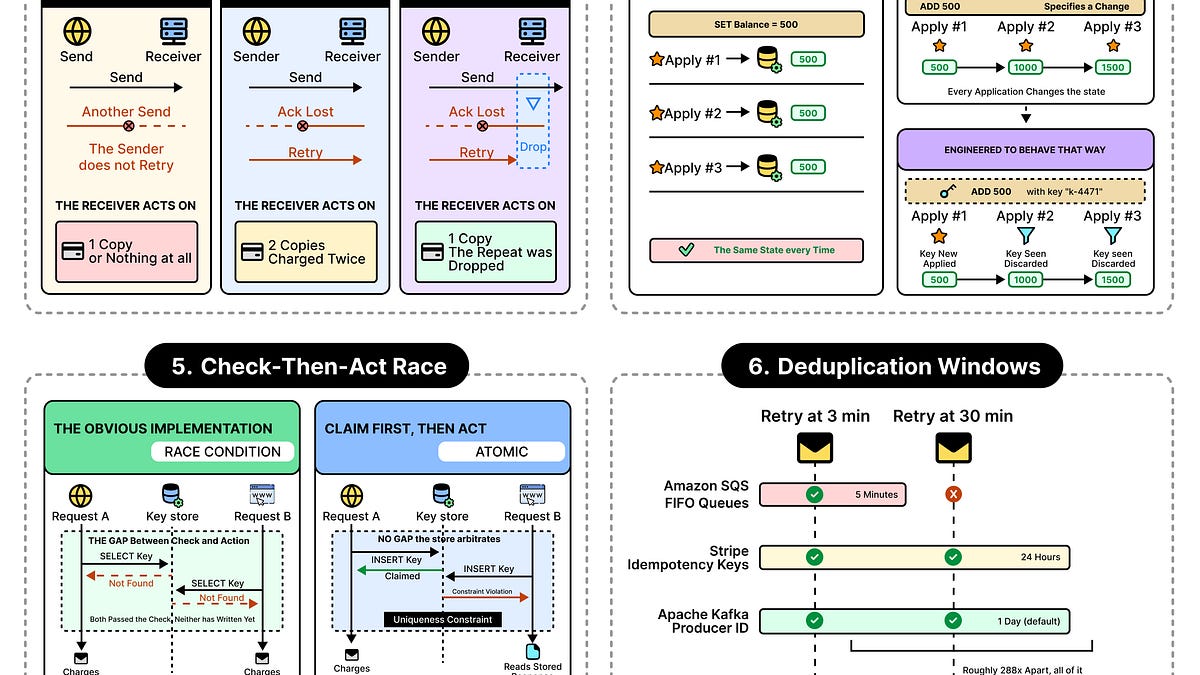
Pre-read: AI agents are making old distributed-systems problems visible to product teams that used to rely on human operators for judgment and cleanup. Payments, webhooks, queues, workflow engines, and tool-calling agents all face the same hard boundary: a timeout does not reveal whether the side effect happened. ByteByteGo's delivery-semantics guide separately frames exactly-once as the hardest guarantee, with real cost in performance and complexity. This explainer is worth opening because it puts names on the failure modes behind duplicate charges, repeated actions, and unsafe retries.
Summary: ByteByteGo starts with a payment request that times out after a charge attempt: retrying can double-charge the customer, while refusing to retry can lose the transaction. It defines idempotency as the property that makes a retry safe, then distinguishes naturally idempotent operations from endpoints engineered to behave idempotently. The article's preview maps the rest of the problem through delivery semantics, producer/broker/consumer duplication points, idempotency-key design, deduplication windows, and the practical limits of exactly-once claims.
The strongest idea is that deduplication is always scoped. A fix at the producer does not eliminate duplicates introduced by the broker or consumer, and a deduplication window loses force after its retention period. For agentic systems, that means a serious tool-execution layer needs durable operation identity, downstream propagation, and explicit recovery behavior. Generic retry logic is a liability once the action touches money, inventory, permissions, customer communication, or external systems.
 3-2-1: On the magic of wanting less, changing inch by inch, and building a sense of hope
James Clear's strongest thread this week is measurement drift: visible numbers become targets because they're easy to see, even when they crowd out better questions about how to live. The practical note is deliberately small-scale, arguing that real change compounds through the next few minutes rather than sweeping reinvention. It is a useful reset if you want a short prompt about ambition, focus, and agency rather than another tactical article.
Ideation
Sell ops and platform teams a control plane that makes an AI agent's irreversible actions provable, replay-safe, and reversible where possible. The primitive is not agent observability; it is custody of side effects. Every refund, shipment change, CRM write, entitlement update, supplier order, or customer message gets a durable operation ID, a semantic idempotency contract, a policy gate, and a reconciliation record that can tell finance, support, and compliance exactly what happened.
Source Signals
- The Pulse: Quitting Spotify Podcasts over reliability via The Pragmatic Engineer
A creator left Spotify video podcasts after repeated publishing failures and weak incident transparency; the lesson is that AI-assisted velocity does not matter if customer-visible operations become less reliable. - A Detailed Guide to Idempotency, Delivery Semantics, and Deduplication via ByteByteGo
The payment-timeout example is the same failure mode agents create at business scale: retrying can duplicate a side effect, while not retrying can lose the action. - The Idempotency Problem in Agentic Tool Calling via Prior check
The generic problem is already known, so the wedge has to own cross-system action custody rather than publish another framework pattern. - Securing Agents Across Perplexity's Client Endpoints with Numbat via Prior check
Endpoint agent monitoring is becoming visible and open source; the differentiated gap is post-decision business effects, not just activity detection.
Why Now
Agents are moving from drafting work to executing work, and the failure mode shifts from bad text to duplicate charges, wrong shipments, accidental refunds, broken entitlements, and unexplainable customer communications. At the same time, AI-assisted engineering raises change volume inside the platforms that customers depend on. The buyer now needs evidence that an autonomous system did exactly one intended business action, or a clean path to compensate when it did not.
First Wedge
Start with fintech, marketplace, and healthcare ops teams letting agents handle refunds, disputes, eligibility changes, or order exceptions. Ship a gateway plus SDK that wraps the agent's tools: reserve operation ID, check policy, execute once, cache result, reconcile downstream state, and produce an audit packet for support and compliance.
Commercial Model
The buyer is the head of platform ops, risk ops, or engineering productivity at a company already piloting agents on paid workflows. Charge a platform fee plus volume pricing per committed action, with higher tiers for regulated audit retention and reconciliation connectors. Budget exists because one duplicate refund batch, compliance incident, or customer-visible workflow failure can cost more than the annual contract.
Defensibility
The system compounds through connectors and incident data: which APIs actually honor idempotency, which side effects need compensation, what policies stop expensive mistakes, and what audit proof satisfies each buyer's compliance team. Incumbent observability tools can see traces, and workflow engines can run steps, but neither naturally owns the semantic contract between an agent's intent and the external business effect.
Technical Risk
The hard part is not storing idempotency keys. It is normalizing side effects across APIs that have weak or inconsistent idempotency support, detecting when an external system committed without returning a result, and designing compensating actions that do not create a second incident. The product needs a narrow catalog of supported actions before it earns trust.
Market Expansion
After refunds and order exceptions, expand into procurement approvals, payroll corrections, entitlement administration, claims operations, regulated customer messaging, and eventually robot or drone dispatch. The common shape is an autonomous system taking an external action where retry, delay, or ambiguity has real-world cost.
Self-Critique
This can fail if serious buyers keep agents away from irreversible actions for another year, or if Temporal, Stripe-style internal platforms, and agent frameworks absorb enough of the problem. The wedge must avoid becoming a generic middleware layer; it needs painful vertical actions, prebuilt connectors, and audit packets that a buyer cannot get by adding a retry table.
Next Experiment
In two weeks, interview ten ops or platform teams already letting agents touch refunds, tickets, orders, or entitlements. Ask for the last ambiguous action incident, map the APIs involved, and build one working wrapper for a high-risk flow such as duplicate-refund prevention with reconciliation against Stripe, Zendesk, and the internal order database.