World
1 critical / 0 happenings
Pre-read: China's low-altitude economy is becoming an industrial-policy test bed, and flying cars are only one visible expression of a broader race around drones, air taxis, batteries, control systems, and local supply chains. Xpeng has already claimed more than 7,000 orders for its modular flying car, with production planned around 2027, according to MarketWatch's report on Reuters' Beijing Auto Show interview.
Legacy automakers still have engineering depth, but speed, local procurement, and regulatory fluency increasingly determine who gets to define new vehicle categories in China. Reuters' story is worth opening because it shows how those constraints beat brand scale.
Summary: Reuters reconstructs Volkswagen's failed effort to build a luxury flying car in China after launching an internal Beijing startup team in 2019. The project was meant to give VW a fast, local route into drones, air taxis, and below-1,000-meter aviation services, but the company remained grounded while Chinese rivals, local governments, and supply chains moved faster.
The newsletter summary points to a familiar mechanism: VW's deliberative culture and compliance safeguards slowed a moonshot that needed local-market tempo. The reported failure now reads as a case study in Western incumbents trying to localize deep-tech products under Chinese speed norms. It also extends the broader auto story: Chinese competitors are not only taking EV share, they are setting the pace in adjacent mobility categories where software, batteries, manufacturing, and permissioning collide.
Tech
1 critical / 1 happenings
 Is America ready for this quirky Jeep-looking EV that can park itself?
Pre-read: Low-speed vehicles sit in a regulatory pocket that makes autonomy cheaper to test: federal rules cap them at 25 mph and generally keep them on roads posted 35 mph or below, a structure Electrek notes puts Chip in the neighborhood-EV category rather than the normal car market. That matters because embodied AI companies can trade highway generality for controlled operating domains, remote supervision, and local use cases.
The interesting question is whether a consumer robot can arrive first as a small vehicle instead of a humanoid. This piece clarifies the practical bet.
Summary: Andrew J. Hawkins reports that Chip Motors is launching a $15,000 to $18,000 electric low-speed vehicle for short local trips, with four- and six-seat versions, a 25 mph top speed, an estimated 100-mile range, and deliveries targeted for 2027. The company pitches the vehicle as expressive and family-friendly, with an LED face, voice features, and a software layer meant to remove friction around short errands.
The autonomy claim is narrower than the marketing vibe. Chip's first driverless feature, Chip Go, relies on remote human operators for parking, pickup, and errands while the cabin is empty, and CEO Jameson Detweiler says the company intends to take legal responsibility during remote operation. That makes the launch less a self-driving breakthrough than an operations design: constrain the vehicle, constrain the roads, keep the human in the loop, and sell the user a robot-shaped convenience layer.
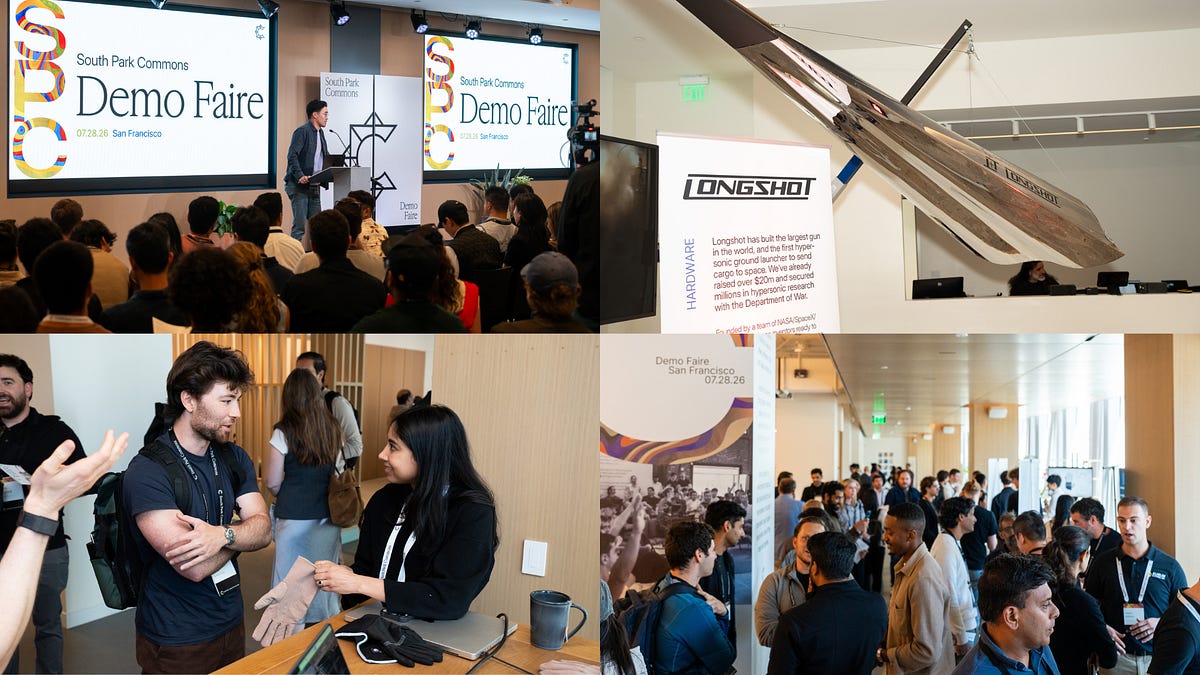 SPC's portfolio tilts toward physical AI
Pre-read: Startup communities are useful demand sensors because they reveal what technical founders are choosing before public markets or incumbents validate the category. SPC's recent public programming around physical AI, including a Viam robotics hackathon where teams built with real robot arms, makes its July update worth reading as a portfolio signal rather than a press roundup.
Summary: SPC says July included its largest Demo Faire yet, with more than 25 companies demoing in San Francisco across hypersonic ground launchers, wildfire sensors, drug chemistry, enterprise agents, and generative fashion intelligence. The fund update names Preseen's $5.6 million seed for global macro forecasting agents and Nirva's $8 million seed for an AI wearable that turns a user's day into a journal, coach, and companion.
The update also points to a cluster of physical and simulation-heavy projects: Chip Motors launched its low-speed Life Utility Vehicle, Jake built armcade.tv for remote robot chess, David built an NYC digital twin, and SPC held a robotics hack day with Viam. The through line is useful: software-native founders are pushing into atoms, but the value is increasingly in operating constraints, real-world data, and deployment loops rather than demos alone.
Ideation
Sell enterprises an independent acceptance package for AI-generated code before it merges into regulated or contract-sensitive systems. The primitive is not another reviewer bot; it is a signed evidence file that says which agent changed what, what spec it was supposed to satisfy, which checks were independent of the generating agent, and which risks a buyer, auditor, insurer, or acquirer can rely on.
Source Signals
- Hiring: Part Time Instructor, Write Production Grade Code with AI via ByteByteGo
The course brief centers on specs, context management, verification, security, legacy code, review, and avoiding AI slop; that is a workflow-budget signal, not just an education signal. - Code Review Agent Benchmark via arXiv
c-CRAB found current review agents still miss much of the human-review benchmark, which makes correlated generator-plus-reviewer risk a real product gap. - Amazon targets agent safety gains with investment in team behind Lean programming language via ITPro
Amazon's Lean backing points to a market shift toward inspectable proofs and policy guarantees for autonomous agents.
Why Now
Coding agents are cheap enough that code volume can rise faster than senior review capacity. At the same time, enterprises, acquirers, cyber insurers, and procurement teams are starting to care about how AI-written code was governed, not just whether the demo works.
First Wedge
A GitHub/GitLab check for fintech, healthcare, and government-vendor repos that produces an AI-change acceptance dossier on every agent-authored pull request: provenance, spec trace, independent tests, dependency diff, security triage, reviewer separation, and a human signoff trail.
Commercial Model
Security, platform engineering, or compliance teams pay per repo or per accepted agent-authored change. The first budget comes from release risk, SOC2/ISO controls, vendor security questionnaires, and M&A technical diligence where undocumented AI code becomes a deal risk.
Defensibility
The moat is the growing corpus of accepted and rejected AI code changes mapped to real production incidents, audit outcomes, and regulator/customer objections. Incumbent code scanners can add AI language, but they do not own the neutral acceptance record across agents, repos, insurers, and buyers.
Technical Risk
The hard part is proving useful independence. The system has to detect when the reviewing model shares failure modes with the generating model, decide which claims need deterministic tests or formal specs, and produce evidence that auditors will trust without slowing every merge to a crawl.
Market Expansion
Start with AI-authored code in regulated SaaS repos, then expand to vendor-security evidence, software warranties, cyber-insurance underwriting, open-source maintainer gates, and acquisition diligence for AI-heavy engineering teams.
Self-Critique
This could collapse into a nicer CI dashboard if buyers do not yet demand independent evidence. It also has to avoid competing head-on with every AppSec platform; the wedge must stay on acceptance and liability around agent-authored changes.
Next Experiment
In two weeks, run 30 recent AI-authored pull requests from three willing teams through a manual acceptance dossier. Measure which evidence security reviewers actually use, what blocks merge, and whether a compliance lead would pay for the signed packet.
Build the operations and compliance layer for neighborhood robots that look like vehicles before they look like humanoids. The first product is a control room and evidence ledger for low-speed EVs, golf carts, campus shuttles, delivery carts, and mobile service robots that use remote operators for parking, dispatch, exception handling, and early autonomy.
Source Signals
- July 2026 Update via South Park Commons
SPC's update links the same month across robotics hack days, remote robot chess, NYC simulation, and Chip Motors' LUV launch; builders are moving from software demos into embodied deployment. - Hello, Robot! 1-Day Hackathon with Viam and SPC via MassRobotics
The event gave software builders real robot arms and a platform quickstart, which points to robotics becoming accessible before operations are mature. - Is America ready for this quirky Jeep-looking EV that can park itself? via The Verge
Chip's near-term autonomy features depend on remote operators in a low-speed operating domain, not full self-driving from day one. - Robotics startup Generalist AI is in talks to raise a new funding round at a $3 billion valuation via Business Insider
Capital is flooding into robot brains, which makes deployment governance, incident evidence, and operator networks the less crowded adjacent wedge.
Why Now
Physical AI funding is crowded around robot brains and humanoids. The contrarian wedge is that the first mass-market robots may be slow, wheeled, geofenced, and boring enough for remote operators and local permits, but still need professional-grade operations before insurers and municipalities tolerate them.
First Wedge
A managed teleoperation and incident-compliance stack for private communities, resorts, campuses, airports, and LSV fleets: operator staffing, live takeover, route geofences, local rule packs, video/event retention, near-miss logs, and insurer-ready safety reports.
Commercial Model
Fleet owners, robot startups, campuses, and property operators pay a monthly platform fee plus per-vehicle remote-ops minutes. Budget exists because one serious incident, denied insurance policy, or local ban can kill a deployment.
Defensibility
Each deployment produces an operating-domain library: risky intersections, radio dead zones, handoff patterns, local rules, operator interventions, and insurer objections. That dataset compounds across vehicle types, while a single robot OEM is biased toward its own hardware and cannot easily become the neutral bureau for cities and insurers.
Technical Risk
Latency is not the only hard problem. The product has to classify when autonomy, teleoperation, or human dispatch is legally and physically safe; preserve useful evidence without drowning operators; and keep handoffs reliable in messy local connectivity.
Market Expansion
Start with low-speed vehicles in controlled private or semi-private domains, then expand to sidewalk delivery, mobile security patrols, warehouse-yard robots, outdoor maintenance machines, and municipal pilot certification.
Self-Critique
The market could be too early if fleets remain tiny through 2027, and OEMs may try to run remote ops themselves. The company only works if it owns the cross-OEM trust layer: insurers, local authorities, trained operators, and incident evidence.
Next Experiment
Interview 10 LSV or campus-mobility operators, 5 robot OEMs, and 3 specialty insurers. Offer a manual safety packet for one pilot route: geofence, connectivity map, takeover protocol, incident form, and monthly risk report. Sell it before building the full console.